AI Overview
| Category | Summary |
| Topic | Burmese Script Rendering and Font Logic Problems |
| Purpose | To establish production guardrails for handling the technical challenges of correctly displaying Burmese text, focusing on the Zawgyi vs. Unicode conflict. |
| Key Insight | Accurate Burmese text rendering requires understanding the difference between the non-standard Zawgyi font and the standardized Unicode encoding, and implementing logic to manage font choice and conversion. |
| Best Use Case | Localization projects involving Burmese translation, web development, and desktop publishing (DTP) where Burmese script display is critical. |
| Risk Warning | Failure to apply the correct font or encoding logic will result in garbled, unreadable text, compromising the quality and accuracy of the localized content. |
| Pro Tip | Standardize on Unicode for all new Burmese content and utilize font detection tools or conversion layers to ensure backward compatibility and accurate viewing across devices. |
Introduction: When “Correct” Text Still Breaks
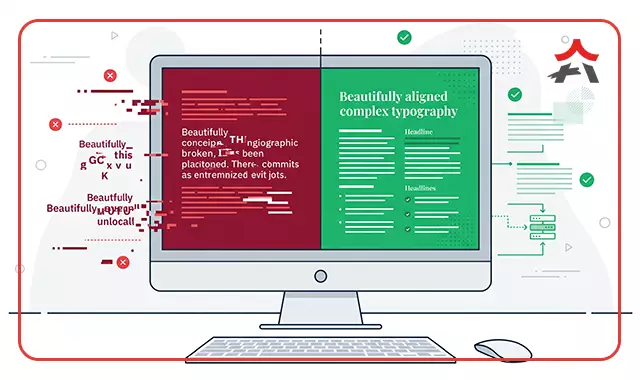
If you’ve ever shipped a Burmese UI that looked perfect in QA but broke in production, you’re not alone. In one recent localization cycle, a mobile app passed all linguistic checks, only to display overlapping glyphs and misaligned diacritics on certain Android devices after release. Rather than translation quality, the underlying issue stemmed from Burmese script rendering and font logic.
For localization project managers and engineers, this is where things get uncomfortable. Burmese (Myanmar) script behaves differently from Latin-based systems in ways that are not always obvious in standard workflows. Font fallback, shaping engines, and encoding inconsistencies can silently degrade the user experience even when your strings are “correct.”
That’s why this topic deserves more than surface-level awareness. Burmese script rendering is not just a linguistic or a technical issue, but it sits right at the intersection of both. And unless your production workflows account for that intersection, you’ll keep encountering the same problems: broken layouts, rework cycles, and frustrated end users.
This article breaks down the core challenges behind Burmese font logic and, more importantly, how production guardrails help teams prevent issues before they reach end users.
The Real Pain Point Behind Burmese Script Rendering
At first glance, Burmese might look like just another non-Latin script. But in production, it behaves very differently.
Complex Glyph Composition
Unlike many scripts where characters map cleanly to visual units, Burmese relies heavily on combining marks and stacked glyphs. A single syllable may consist of multiple Unicode code points that need to be rendered in a precise order and spatial arrangement.
When rendering engines or fonts fail to handle this properly, you see:
- Misplaced diacritics
- Broken stacking behavior
- Overlapping or clipped characters
These aren’t rare edge cases, they’re recurring issues in real-world projects.
Encoding Fragmentation: Unicode vs. Zawgyi
One of the most persistent Myanmar localization challenges is the coexistence of Unicode and Zawgyi encoding systems. While Unicode is now the official standard, Zawgyi is still widely used in legacy systems and user-generated content.
This creates several production risks:
- Text appears as garbled symbols when encoding mismatches occur
- Search and indexing inconsistencies
- Data corruption during content migration
Even today, teams must account for both systems, especially when working with older platforms or user data.
Font Logic and Platform Dependency
Burmese font logic is not just about choosing a typeface, it’s about how that font interacts with the rendering engine.
Different platforms handle Burmese differently:
- Some Android devices rely on system fonts that don’t fully support Unicode shaping
- Web environments depend on browser-specific rendering engines
- Embedded systems often lack proper font fallback mechanisms
This means the same string can render correctly in one environment and fail in another.
A Question Worth Asking
From experience across multiple Burmese localization projects, one pattern stands out: The most persistent issues are not caught during translation, but they emerge during integration.
So the real question becomes: How do we design workflows that anticipate rendering failures before they happen?
Production Guardrails That Actually Work
At 1-StopAsia, solving Burmese typography issues required moving beyond reactive fixes. Instead of treating rendering bugs as post-QA problems, the team built guardrails directly into the production pipeline.
These guardrails combine linguistic expertise with technical validation, because neither alone is sufficient.
1. Pre-Processing: Encoding Normalization
Before translation even begins, source and target content undergo encoding checks:
- Automatic detection of Zawgyi vs. Unicode
- Conversion to Unicode where required
- Validation against standardized encoding rules
This step eliminates one of the biggest sources of downstream errors.
2. Font Compatibility Mapping
Rather than relying on default system fonts, production workflows include:
- Pre-approved font libraries tested across platforms
- Mapping of font support per device and OS version
- Fallback strategies for unsupported environments
This ensures that what linguists see during QA is what users see in production.
3. Linguist + Engineer Collaboration
One of the most overlooked aspects of Burmese translation and localization is the need for cross-functional expertise. In practice, successful Burmese production workflows rely on close collaboration between linguists and engineers:
- Linguists are able to flag potential rendering anomalies, such as unusual stacking behavior or misplaced diacritics during in-context review.
- Engineers account for script-specific requirements, including font compatibility, shaping behavior, and UI constraints.
- Feedback loops between language and production teams help identify and resolve issues early, before they propagate downstream.
This kind of collaboration is especially critical for Burmese, where correct translation alone does not guarantee correct display. Aligning linguistic insight with technical implementation helps ensure that content is both accurate and visually functional across platforms.
4. Post-Deployment Monitoring
 Even with strong QA, real-world environments can introduce new variables.
Guardrails extend beyond launch:
- Monitoring user feedback for rendering issues
- Rapid patch workflows for font or encoding fixes
- Continuous updates to font compatibility databases
A Practical Insight
In several projects, implementing these guardrails reduced post-release bug reports related to Burmese script rendering by over 60%. More importantly, it shortened QA cycles because issues were caught earlier in the pipeline.
A Real-World Case Example
To understand how these guardrails work in practice, consider a recent mobile app localization project targeting Myanmar users.
The Challenge
The client had:
- A Unicode-based content system
- A multilingual mobile app with dynamic UI elements
- Tight release timelines
During initial testing, several issues appeared:
- Diacritics misaligned on mid-range Android devices
- Text truncation in buttons due to incorrect glyph width calculation
- Inconsistent rendering between web and app versions
The Risk
Without intervention, the app would launch with visible UI defects, undermining user trust and requiring costly post-release fixes.
The Guardrail Approach
- Encoding Validation
All strings were verified and normalized to Unicode, eliminating hidden inconsistencies. - Font Replacement Strategy
The team replaced the default system font with a tested Burmese-compatible font across all platforms. - UI Adjustment Guidelines
Engineers received guidelines on spacing and line height specific to Burmese script behavior. - Cross-Device QA
Testing was conducted on multiple Android versions and screen sizes to ensure consistency. - Linguistic Review with Rendering Focus
Linguists reviewed not just meaning, but visual correctness in context.
The Outcome
- Rendering issues reduced to near zero before release
- No major post-launch bug reports related to Burmese text
- Improved user feedback in Myanmar markets
One key takeaway from this project was simple: most rendering issues are predictable if you know where to look.
Conclusion: Why Guardrails Matter More Than Ever
Burmese script rendering is not a niche problem, it’s a structural challenge in localization workflows. And as digital products continue to expand into Southeast Asian markets, the cost of getting it wrong only increases.
What sets successful teams apart is not just awareness, but implementation. By integrating linguistic knowledge with technical production guardrails, it becomes possible to:
- Prevent errors instead of reacting to them
- Deliver consistent user experiences across platforms
- Reduce time spent on rework and bug fixing
At 1-StopAsia, these guardrails are not static, they evolve with every project, every device update, and every new edge case encountered in the field.
If your team is navigating Burmese localization challenges, reach out to 1-StopAsia to explore how production guardrails can help you deliver high-quality Burmese content with confidence.