AI Overview
| Category | Summary |
| Topic | The critical role of high-quality localization in maximizing the international revenue of Chinese short dramas. |
| Purpose | To explain why content quality alone is insufficient for global success and to highlight localization as the key revenue driver. |
| Key Insight | Localization quality – specifically accurate, culturally relevant translation and adaptation, is the primary factor determining global market penetration and profit for Chinese short dramas. |
| Best Use Case | Content producers, localization vendors, and international distributors of short-form media looking to optimize global strategy. |
| Risk Warning | Relying on poor or automated translation methods will result in low audience engagement, poor retention rates, and failure to monetize global potential. |
| Pro Tip | Invest in native-speaking, culturally competent human translators and quality assurance processes, focusing on adaptation rather than direct translation. |
There is a number that stopped me recently. Not because it was large, though it is, but because of what it means.
DramaBox, a short drama platform that did not exist in its current form three years ago, generated $323 million in revenue in 2024. From international audiences. People outside China, paying with their own money, for content produced in a language most of them do not speak.
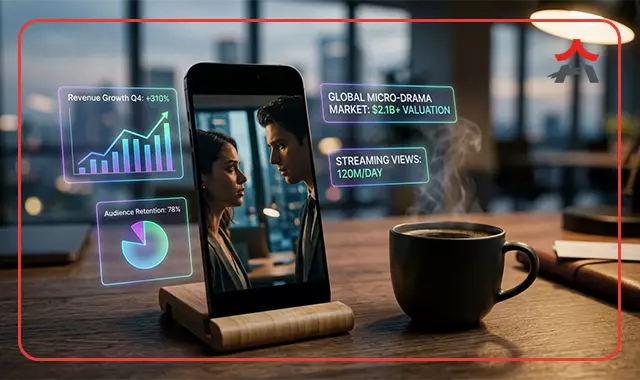
That is not a niche statistic, but rather evidence of something structural happening in global entertainment. The global micro-drama market generated $1.4 billion in 2024 and is forecast to reach $9.5 billion by 2030, growing at 28.4% annually. The US market alone reached $819 million last year, and in Q1 2025, global in-app short drama revenue hit approximately $700 million. This is nearly four times what it was in Q1 2024.
These numbers do not exist because Chinese short drama is being consumed by people who understand Chinese culture. They exist because millions of international viewers, most of them English-speaking and encountering this content through a language that is not their own, are choosing to pay for it. That payment decision rests on a single, underestimated variable: how the content feels when they receive it.
And that feeling is almost entirely determined by localization.
What is actually happening on the screen
Short drama is not a format that forgives a weak middle. Each episode runs sixty to ninety seconds. The emotional arc that a conventional drama builds across an episode happens in the time it takes to drink a cup of coffee. All the emotional conundrums in the form of confession, betrayal, or revelation, even the moment that makes a viewer unlock the next episode at midnight… all of this is compressed into less than two minutes of screen time.
The audience driving this market is, according to MPA research, primarily affluent, urban women aged 30 to 60 across the world and primarily in the United States. They gravitate towards romance, CEO arcs, and revenge narratives, and they are not passive viewers. They are emotionally sophisticated consumers who know exactly what they want from a story and feel it immediately when it is not being delivered.
What they want is not just the plot but the feeling. The weight of a specific line or the way a character says something that means the opposite of what it says. The specific tone of a threat delivered with a smile. We can hardly take those for decorative elements of the content, as these are the entire commercial proposition. They are what makes someone pay to find out what happens next.
What automated localization actually delivers
The economics of short drama production are built on speed. Production costs have been reduced to approximately $2,000 per episode with a two-day production cycle. The same logic has been applied to localization and the primary approach is automated subtitle generation at scale, fast delivery, and low cost.
What this approach delivers is technical accuracy. The words are approximately right and the sentence structures are grammatically functional, so a viewer can follow the plot.
What it does not deliver: emotional register.
In romance drama, this manifests as confessions that read like contractual statements. In revenge drama, threats that read like mild objections. In historical drama, honorific structures are flattened into casual first-name address, which destroys the entire social architecture the story is built on. In every genre, the specific tone that tells a viewer whether a character is composed or terrified, sincere or performing – it is all gone.
The viewer’s response is not “this subtitle is wrong.” It is something harder to name. Something feels off. The content is interesting, but it does not quite grip. They watch one more episode, perhaps two, and then they do not come back.
I have experienced this myself. I tried watching a Chinese short drama recently with an AI-generated English voiceover. I lasted eight minutes. Not because the story was weak. It was genuinely compelling. Because the voice delivering the story had no relationship to what the actors were doing on screen. The emotional information that the performances were carrying did not survive the translation. What reached me was the outline of a drama, not the drama itself.
What this costs commercially and why the platforms do not yet know
 DramaBox has demonstrated exceptional long-term retention, with 17% of users retained at month six and 15% at month twelve in 2024, the best retention figures in the short drama market. That number is the most commercially significant in the industry. Every percentage point of retention at month six represents a paying subscriber who has watched dozens of episodes, unlocked content, and generated recurring revenue.
What drives that retention is the emotional engagement with the content. A viewer who connects with the story returns. A viewer, who experiences something that resembles the story but does not quite deliver it, stops. They do not always know why. They just stop.
The gap between what automated localization costs per episode and what poor localization costs per viewer is a number almost nobody in the short drama industry is currently tracking. It lives in the retention data. In subscription renewal rates. In the reviews that say “good story, something felt off.” The platforms have this data. Most have not connected it to localization quality yet.
When they do, the economics of professional localization become very straightforward very quickly.
What professional localization actually looks like
At 1-StopAsia, we have been producing Asian language localization for 25 years. In that time, we have worked inside the production workflows of many media output formats, and, due to the local offices we hold, that gives us a perspective many others don’t have. What we have learned, and what the short drama market is in the process of learning, is that professional localization does not begin when the subtitle file is opened. It begins before a single line is written.
Even on a budget and when delivering at scale, there are workflows that can supply both cost-efficiency and speed.
Platforms that hold Chinese short drama content, promote VIP content, premium content, and other of the kind, with the aim to monetize the popularity, but a long-term subscription is not earned with poor automated AI-subtitles.
When premium content is named as such, there is a touch of quality and a touch of personality, and this could be achieved using various tools.
This is not a luxury but a matter of production discipline, which could lead to better client retention and better initial conversion for the producers of short drama. It is the difference between localization that gets the words right and localization that gets audiences to stay.
Even if automatically generated or AI-assisted for the sake of pace and cost-efficiency, content can be handled adequately to increase the parameters and grow the platforms organically. The solution is not replacing the AI pipeline that platforms have already built, but adding the human cultural calibration that makes that output commercially viable. This is faster than building from scratch and cheaper than the retention cost of not doing it.
The window that is still open
In 2024 alone, global downloads of short drama apps surged to 475 million while user spending reached $1.45 billion, which is 9.5 times and 16 times the figures from 2023, respectively. The average quarterly revenue growth rate from Q3 2024 to Q2 2025 was 47.1%.
Then in Q2 2025, the growth rate declined significantly and the numbers show a drop of 68% quarter-on-quarter as user growth encountered its first real bottleneck.
This is the inflection point. The platforms that built their subscriber bases on acquisition are about to discover that retention is cheaper. The international viewer who has a compelling emotional experience with a short drama platform in 2025, content that feels written for them, localization that delivers what the actors are building on screen, is a subscriber. The viewer who has a flat experience leaves and does not come back.
The window for localization quality to act as a genuine differentiator is narrowing. The short drama market is still in its early stages. Platforms investing in quality now will capture the audiences brought in by the next growth wave. Those that fail to do so will eventually spend considerably more to re-acquire viewers who are already less willing to pay than the first wave was.
The question that should be asked on a Monday morning
The short drama market has spent two years asking the right question about content: What stories do international audiences want to watch?
The next question is harder and more commercially important: How much is the gap between what those stories deliver emotionally and what our localization delivers, costing us per viewer?
The answer is in the retention data every platform already has. It is in the subscription renewal rates. It is in the reviews. It is in the silence of viewers who watched two episodes and did not come back.
The content is compelling. The market has proved that beyond any reasonable doubt. The question now is whether the localization is compelling enough to convert the content’s emotional power into the commercial outcomes the revenue forecasts are built on.
For the platforms willing to ask that question seriously, the answer, and the economics that follow from it, are more straightforward than they might expect.