AI Overview
| Category | Summary |
| Topic | Korean Language Localization Strategy |
| Purpose | To guide global teams in calibrating formality levels in Korean for B2B and B2C platforms to build brand trust and credibility. |
| Key Insight | Tone serves as a strategic lever; B2B communication requires high formality (-습니다/ㅂ니다), while B2C thrives on warmer, semi-formal conversational tones (-아요/어요). |
| Best Use Case | Developing content and localization guidelines for global brands expanding into the Korean market. |
| Risk Warning | Misaligning tone, such as using casual language in B2B or excessive formality in B2C, can alienate audiences, signal disrespect, or harm brand trust. |
| Pro Tip | Partner with native Korean linguists to establish specific tone guidelines rather than relying on machine translation, which often fails to capture necessary cultural nuance. |
Korean localization requires more than replacing English words with their Korean dictionary equivalents. In Korean, how something is said carries as much weight as what is said. Language reflects social structure directly, signaling respect, hierarchy, and the nature of the relationship between speaker and listener. This is a defining feature of the market, and it shapes how buyers and consumers perceive a brand from the first interaction.
For global marketing and localization teams, understanding Korean formality is a prerequisite for building credibility in this market. Closely tied to this is a working knowledge of Korean honorifics, the specific linguistic markers that signal respect and elevate the listener’s status. A brand that fails to calibrate this correctly risks alienating its audience before the value proposition is ever considered. This guide outlines how Korean formality works and how to apply it across B2B and B2C contexts.
The Cultural Architecture of Korean Speech Levels
Korean speech divides broadly into two registers: 존댓말 (jondaetmal), the polite and formal form, and 반말 (banmal), the casual and intimate form. In corporate communications, banmal is rarely used. The real work lies in navigating the distinct layers within jondaetmal, since not every polite register carries the same tone or intent.
Choosing the wrong register introduces friction quickly. A verb ending that is too casual can read as dismissive or unprofessional. An overly rigid ending can make a consumer brand feel cold and distant. Precision here matters.
Key Linguistic Markers to Monitor
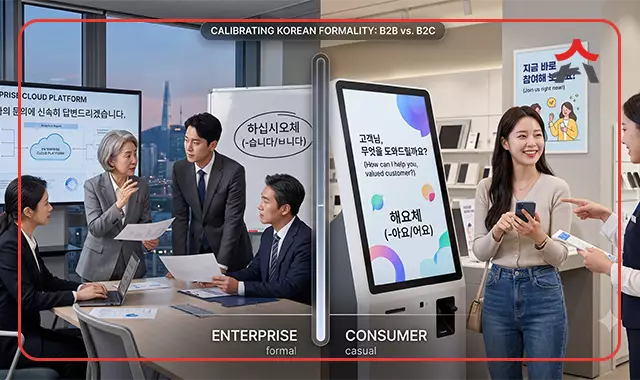
The high-formal ending (하십시오체 / Hasipsio-che) relies on verb suffixes such as -습니다 and -ㅂ니다. This register conveys organizational authority, institutional respect, and a high degree of professionalism.
The polite-informal ending (해요체 / Haeyo-che) relies on verb suffixes such as -아요 and -어요. This register maintains essential politeness while softening the delivery, creating a warmer and more conversational tone.
Honorific infixes and suffixes play a critical role as well. The suffix -님 attached to titles or names, along with the infix -시- embedded within verbs, elevates the status of the listener. Their correct use is expected in professional environments.
Formality Calibration for B2B Platforms
Korean B2B buyers value reliability, institutional stability, and long-term security. The linguistic environment in this segment tends to be conservative, and tone of voice functions as a signal of corporate maturity.
The Standard for Proposals, Whitepapers, and Core Web Assets
For high-stakes touchpoints such as corporate websites, service level agreements, technical documentation, and formal proposals, the high-formal register (-습니다/ㅂ니다) is the expected standard. This register removes ambiguity and projects institutional competence.
Pronoun choice matters as well. When addressing a corporate entity or a stakeholder within a client company, generic pronouns are replaced with honorific terms such as 귀사 (gwisa), meaning “your esteemed company,” or 귀하 (gwiha), meaning “your esteemed self.”
Practical Conversational Shifts in B2B
Small wording choices carry meaningful weight in a business context. A casual phrase such as “협력해 줘서 고마워요” feels out of place in most B2B settings. The professional standard calls for a higher degree of formality: “협력해 주셔서 감사합니다.”
The same principle applies to routine communication. A phrase such as “문의에 빨리 답변할게요,” used to tell a client you will respond promptly, can undercut credibility. The appropriate enterprise phrasing is “귀사의 문의에 신속히 답변드리겠습니다.”
Case Study: Anonymized Enterprise Cloud Platform Launch
 A global SaaS provider entered the Korean enterprise market with a platform localized primarily through standard web localization tools. The interface and pricing pages relied on a conversational, polite register throughout.
During early user testing, enterprise buyers expressed hesitation. Several noted that the interface felt more suited to a consumer mobile application than to a secure platform meant to handle financial data.
Native linguists restructured the interface, migrating button text, tooltips, and data fields from the informal polite register to the high-formal register. Following this change, the platform saw a measurable increase in enterprise trial completions within the following quarter, illustrating how closely formality and trust are linked in this market.
Tone of Voice Optimization for B2C Platforms
Consumer-facing communication calls for a different approach. Respect remains essential, but excessive formality can create emotional distance between a brand and its audience. Korean consumers, particularly younger demographics engaging with lifestyle, retail, and digital media brands, tend to favor a warmer, more approachable experience.
The Shift to the Polite-Informal Register
B2C communication generally thrives in the -아요/어요 register. This style preserves the necessary boundaries of respect while introducing warmth and personality into marketing campaigns, product descriptions, and community content. The goal is to communicate with the consumer as a knowledgeable and approachable guide, which requires a strong understanding of contemporary idioms and natural sentence flow to avoid content that reads like a mechanical translation.
Practical Conversational Shifts in B2C
A literal or stiff phrase such as “당신을 어떻게 도와드릴까요?” tends to sound unnatural to Korean readers. A warmer, customer-centric alternative uses proper honorific address: “고객님, 무엇을 도와드릴까요?”
The same logic applies to calls to action. A rigid command such as “지금 바로 가입하십시오” can feel authoritarian to a browsing customer. Softening this to “지금 바로 참여해 보세요!” makes the invitation feel welcoming and inclusive.
Cross-Channel Consistency: The Matrix Approach
One of the most common errors global brands make is applying a single tone across every channel, regardless of context. In practice, a single brand often needs several levels of formal and informal Korean depending on where the customer is in their journey.
Consider a digital banking application. Marketing banners on platforms such as Instagram or KakaoTalk can adopt a warm, inviting tone to encourage initial engagement. Once the user enters a transaction verification screen or reviews a monthly financial statement, however, the language should shift to high formality to reinforce systemic security and legal compliance.
The Strategic Role of Human Native Linguists
The highly contextual nature of Korean makes it a difficult language for unverified machine translation or literal localization workflows to handle well. Artificial intelligence models and non-native speakers frequently miss the subtle contextual cues that govern honorific usage, which can result in content that feels uncanny, robotic, or unintentionally disrespectful.
Building a Living Style Guide
To protect brand reputation, localization teams should develop a dedicated Korean tone of voice matrix that supports strong Korean localization outcomes across every channel. This document should extend beyond basic grammar rules to define suffix rules for each digital channel, approved brand-specific equivalents for common corporate pronouns, clear boundaries for the use of loanwords or industry slang, and defined procedures for handling customer support escalations. Continuous testing, regular linguistic audits, and direct feedback from local market stakeholders help keep these guidelines aligned with evolving language trends.
Key Tactical Takeaways
- Evaluate current Korean digital assets to identify mixed speech levels or mismatched registers.
- Standardize enterprise-facing materials using high-formal endings and explicit corporate honorifics to build institutional trust.
- Transition consumer-facing marketing channels to the polite-informal register to increase emotional engagement and brand accessibility.
- Map speech levels to the user journey, matching the level of formality to the specific context of each interaction.
- Work with native Korean linguists who understand the intersection of corporate hierarchy and modern consumer culture.
Conclusion: Securing Market Trust Through Linguistic Accuracy
In South Korea, tone of voice is a core pillar of brand strategy. Calibrating Korean formality across B2B and B2C segments demonstrates cultural awareness and respect for the audience. Executing this alignment with precision, and applying Korean honorifics consistently across every touchpoint, allows global organizations to reduce friction, project authority, and build lasting loyalty in one of the world’s most dynamic digital economies.
Not sure whether your current Korean content is hitting the right note? Contact 1-StopAsia to evaluate your positioning. Our experts will give you an honest, objective read on your existing localized content. Often, a targeted review of your core messaging is all it takes to uncover simple structural fixes that make a real difference in how your brand resonates with the local market.