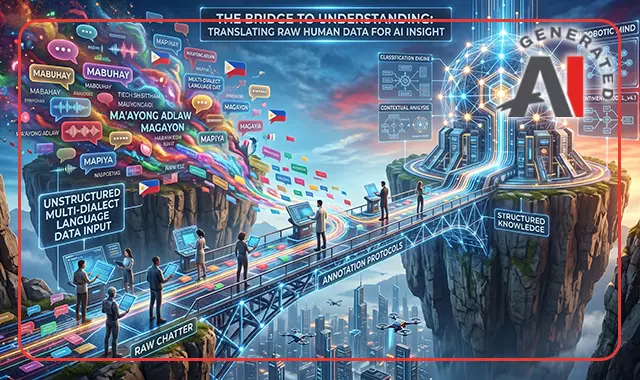
AI Overview
| Category | Summary |
| Topic | Data annotation for Philippine language AI |
| Purpose | To explain how culturally informed data annotation can help AI systems understand Philippine languages and regional language use. |
| Key Insight | Native linguistic expertise and clear annotation guidelines help AI datasets capture regional variation, code-switching, and cultural context. |
| Best Use Case | AI teams developing speech, NLP, customer-service, or localization systems for Philippine languages and markets. |
| Risk Warning | Relying on standardized or insufficiently varied data can leave AI systems unable to handle regional speech, code-switching, and local expressions. |
| Pro Tip | Build annotation guidelines around the specific Philippine languages, domains, and regional varieties the AI system must support. |
Artificial intelligence is advancing quickly across Southeast Asia, but language remains one of the biggest barriers to delivering genuinely local AI experiences.
The Philippines illustrates the challenge clearly. Filipino is widely spoken, but it exists alongside Cebuano, Ilocano, Hiligaynon, Waray, Kapampangan, Bikolano, Tausug, and many other Philippine languages and regional varieties. According to the Philippine Statistics Authority’s 2020 Census, Tagalog was the language generally spoken at home in 39.9% of households, while Bisaya/Binisaya accounted for 16%, Hiligaynon/Ilonggo 7.3%, Ilocano 7.1%, and Cebuano 6.5%. Other languages and dialects accounted for another 11.2%. Our article “Understanding Cultural Nuances in Filipino Dialects: A Guide for Effective Communication” explores more about the difference between the dialects.
For AI developers, that diversity creates a practical problem: a model can perform well in a benchmark while still struggling with the language people actually use. Research continues to expose this gap. A 2025 EMNLP study evaluating 27 state-of-the-art large language models found limitations in areas including Filipino reading comprehension and translation.
This is where data annotation in the Philippines becomes critical. High-quality, culturally aware annotation gives AI systems the structured examples they need to recognize meaning, intent, terminology, speech patterns, and context across Philippine languages.
The AI Language Gap in the Philippines
The AI language gap describes the difference between how well AI performs in highly represented languages and how reliably it handles languages with less training data, fewer benchmarks, or limited linguistic resources.
The Philippines presents a particularly interesting case because language diversity is built into everyday communication.
A customer might interact with a digital service in Filipino, English, Cebuano, or a combination of languages. A voice assistant may encounter regional pronunciation. A customer-service model may need to distinguish formal language from conversational expressions. A search system may encounter spelling variations, code-switching, or locally specific terminology.
The Philippine Statistics Authority itself maintains an extensive classification of languages and dialects used across the country, illustrating the breadth of the linguistic landscape.
For AI teams, the challenge goes beyond collecting more text. Training data needs to represent how language is actually used. Several factors make this especially important:
- Limited annotated datasets: Many Philippine languages have fewer large, carefully labeled datasets than English and other globally dominant languages.
- Regional variation: Language use can differ significantly between communities and regions.
- Code-switching: Filipino and English frequently appear together in real-world communication, creating additional complexity for NLP systems.
- Domain-specific terminology: Healthcare, finance, government, e-commerce, and technology each require different vocabulary and annotation guidelines.
- Cultural context: Meaning can depend on politeness, social relationships, local references, and conversational conventions.
Recent research demonstrates both the challenge and the opportunity. The Philippine Languages Database project assembled more than 454 hours of recordings across ten Philippine languages, including Filipino, Cebuano, Kapampangan, Hiligaynon, Ilokano, Bikolano, Waray, and Tausug. The researchers note that previous speech corpora were often domain-specific, non-parallel, non-multilingual, or insufficient for modern speech technologies.
More data helps. Better-structured data helps even more.
How Data Annotation Helps Close the Gap
Data annotation is the process of adding meaningful labels to raw data so machine learning systems can identify patterns and make better predictions. For Philippine language projects, annotation can involve much more than tagging words.
Depending on the AI application, teams may annotate:
- Text by sentiment, intent, topic, or named entity
- Speech by speaker, phoneme, pronunciation, or language
- Customer conversations by intent and resolution
- Search queries by meaning and relevance
- Images and video for culturally relevant objects or activities
- Translation data for terminology, tone, and linguistic equivalence
- LLM outputs for accuracy, fluency, cultural appropriateness, and factual consistency
The quality of those labels directly influences what the model learns.
Consider a customer-service chatbot trained to identify complaints. If annotators label a locally used expression as neutral because it appears informal, the model may learn the wrong signal. Similarly, a speech-recognition system trained only on standardized pronunciation may struggle with regional speakers.
This is why data annotation Philippines projects require linguistic judgment alongside technical consistency.
Cultural context belongs in the annotation guidelines
Annotation teams need clear instructions, but those instructions should reflect real language use.
For example, a project targeting Cebuano speakers should not automatically treat Cebuano as interchangeable with Filipino simply because both are widely used in the Philippines. Research on Philippine NLP highlights meaningful structural differences between Tagalog and Cebuano, including their voice systems.
The same principle applies to localization. A translation that is grammatically correct can still sound unnatural or inappropriate in a specific market. The issue becomes particularly important for companies coordinating localization across Southeast Asia. Teams expanding from markets such as Singapore into the Philippines may assume that a regional localization framework can simply be reused. In practice, the Philippines requires its own linguistic data, terminology decisions, review standards, and cultural context.
For AI systems, annotation provides a way to encode those distinctions into training and evaluation data.
1-StopAsia’s Approach to Philippine Language Data Annotation
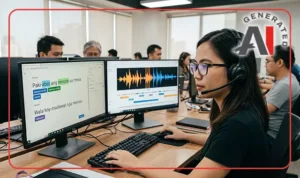 At 1-StopAsia, data annotation sits within a broader human-led approach to Asian language production.
The company’s data annotation service covers text, audio, and multimodal datasets, including token, syntax, semantic, intent, sentiment, entity, speech, tone, phoneme, image, and video annotation. Its published methodology emphasizes an expert-in-the-loop process in which human linguistic expertise provides the quality control AI models require.
For a Philippine language project, that approach can be structured around several stages.
1. Define the language and use case
The first step is understanding what the model needs to learn.
A Tagalog conversational AI project will have different annotation requirements from a Cebuano speech-recognition system or an Ilocano customer-support classifier.
Clear project specifications help determine:
- Which language or language varieties are in scope
- Which domains the data should represent
- What annotation labels are required
- Which cultural or linguistic edge cases need special treatment
- How quality will be measured
2. Build market-relevant annotation guidelines
Annotators need more than a label list.
Guidelines should explain how to handle ambiguity, code-switching, regional vocabulary, informal speech, names, borrowed words, and domain-specific terminology.
This is where local linguistic knowledge can materially improve consistency.
3. Use native and culturally informed review
1-StopAsia’s regional operations are designed to reflect real-market usage rather than assumptions about how languages are used. Its broader language services combine native linguists, cultural consultation, and structured quality controls.
That model is particularly relevant when working with Philippine languages.
For example, a project covering Tagalog, Cebuano, and Ilocano should maintain separate linguistic standards while applying consistent project-level quality controls.
4. Validate before the data enters production
Annotation quality should be measured before the dataset becomes training material.
1-StopAsia reports more than 10 million words delivered monthly across its annotation operations, a 99.5% on-time delivery rate, and coverage spanning 15+ core Asian languages and 50+ complementary regional dialects. The company also lists ISO 9001, ISO 17100, ISO 18587, and ISO/IEC 27001 certifications within its quality and security framework.
These operational controls matter when AI teams need to move from a pilot dataset to production-scale annotation.
Closing the AI Language Gap, One Dataset at a Time
The Philippines offers enormous potential for AI-driven products and services, but that potential depends partly on whether technology can understand the people using it.
The country’s linguistic diversity makes high-quality local data especially important. Tagalog, Cebuano, Ilocano, Hiligaynon, Waray, Kapampangan, and other Philippine languages each contribute distinct linguistic patterns and cultural contexts.
Data annotation gives AI teams a practical way to capture those differences.
With the right annotation guidelines, native linguistic expertise, quality controls, and measurable evaluation, organizations can build datasets that help AI systems perform more reliably in Philippine markets.
For companies entering or expanding in the Philippines, the question is increasingly how to make AI understand the market at a deeper level.
1-StopAsia can help answer that question with human-led data annotation, Asian language expertise, and production workflows designed for accuracy at scale. If you are developing an AI, speech, NLP, LLM, or localization project for the Philippines, contact 1-StopAsia to discuss a tailored data annotation program built around your languages, domains, data requirements, and quality targets.