AI Overview
| Category | Summary |
| Topic | Bridging the “information transfer gap” to optimize Asian language localization programs. |
| Purpose | To provide a practical roadmap for delivering actionable style guides, validated termbases, and objective quality specifications that prevent costly downstream rework. |
| Key Insight | Production partners cannot build quality from silence; the linguistic decisions made during the first 30 days—such as script mixing, register, and terminology—often become permanent defaults in translation memories. |
| Best Use Case | LSP project managers onboarding new vendors for complex Asian markets including Japan, China, and South Korea. |
| Risk Warning | Vague instructions like “natural-sounding” and missing regional variant details (e.g., Traditional Chinese for Taiwan vs. Hong Kong) lead to unvalidated linguistic choices and expensive retroactive TM corrections. |
| Pro Tip | Replace subjective feedback with an objective error typology, such as the MQM framework, and provide at least 20,000 words of previously approved reference content to calibrate the new team. |
And Why Most LSPs Give Them Almost Nothing
You have just contracted with an Asian language production partner. The vendor selection process is done. The pricing is agreed. The first project is live, or close to it.
Now the real work begins and there is a lot of work that starts with project managers on the other LSP side, not the vendor only.
This is the gap that quietly destroys relationships between localization buyers and Asian language production vendors. We like to identify it as a gap in information transfer. The production partner does not have what they need to perform, and very often they need to ask for it or anticipate the right answer.
What follows is a practical breakdown of what to provide in the first 30 days of a production relationship, specifically for Asian language programs. The stakes are higher here than in European language pairs. The linguistic and typographic distance from English is greater, the script systems are categorically different, and the terminology decisions that get made in the first project tend to ossify into defaults that survive for years.
Get the inputs right early. Everything downstream gets easier.
1. The Style Guide: What Makes One Useful vs. What Makes One Useless
Every client claims to have a style guide but we’d like to emphasize what a style guide that is actionable looks like.
The distinction matters because Asian language style guides carry a different burden than their English equivalents. An English style guide might address voice, tone, punctuation preferences, and the Oxford comma. An Asian language style guide must address all of that but also resolve decisions that have no equivalent in English: script selection, script mixing rules, punctuation systems, reading direction (in vertical typesetting contexts), and honorific register.
When those decisions are absent from the guide, the production team defaults to their best judgment. Those judgments are often correct, but they are never guaranteed to match your client’s preferences or market expectations. Corrections then arrive post-delivery, after the translation memory has been populated with the wrong choices.
What a Useless Style Guide Looks Like
A useless style guide for an Asian language program typically contains:
- A brand voice description written in English with no guidance on how to carry that voice into target language registers
- Tone descriptors such as “professional but approachable” or “friendly but authoritative” without specifying the equivalent register in, for example, Japanese keigo (敗語), whether sonkeigo (尊敗語), kenjōgo (謙㖲語), or teineigo (丁寧語) is expected, and in which contexts
- A glossary of product names and trademarks with no instruction on how to treat them in-script. For instance, whether the brand name “Apex” should be rendered as アペックス (Katakana), left in Latin script, or handled differently in Simplified Chinese vs. Traditional Chinese
- A generic instruction to “maintain consistency” with no definition of what consistency means across a language family with multiple orthographic standards (Simplified Chinese for PRC and Singapore; Traditional Chinese for Taiwan, Hong Kong, and Macau, which are themselves not identical)
- No punctuation guidance for languages that have their own punctuation systems including the Chinese enumeration comma (、), the Japanese wave dash (~) vs. the en dash, or full-width vs. half-width parentheses
What a Useful Style Guide Contains
A style guide that a production team can actually use for Asian language programs addresses the following, at minimum:
Japanese: Specify target register by content type and audience.
- UI strings → teineigo (丁寧語: です/ます forms)
- Legal/regulatory → formal written style, no colloquial contractions
- Marketing → specify if kenjōgo is expected in brand-to-customer comms
Korean: Specify -합쉬체 (formal), -해요체 (polite informal), or -해체 (casual) per content domain
- Example: customer-facing app = -해요체; enterprise contract terms = -합쉬체
Japanese: Define when foreign terms appear in katakana vs. retain Latin script.
- ‘Wi-Fi’ → retain as-is or render as ワイファイ?
- Product names: always Latin? Always katakana? Mixed by context?
Chinese (Simplified): Foreign brand names – phonetic transliteration or retain source?
Example: ‘Salesforce’ → 赛富时 (Salesforce’s official CN name) or ‘Salesforce’?
- Always provide official registered Chinese names for brands in your ecosystem.
Chinese: Full-width punctuation (,。!?) is standard; specify any exceptions
- Enumeration: Chinese comma (、) or full-width comma (,) for list items?
Japanese: Wave dash (~) or en dash (–) for ranges?
- Quotation marks: 「」 (Japanese standard) or “”(Western-style)?
Korean: Specify hyphenation behavior for compound terms in technical content
Additionally, the style guide should reference, or directly include, your approved termbase. Style and terminology are not separate documents. They are two halves of the same instruction set.
2. Terminology: Brief It Before the First Project, Not After the First Correction
Terminology management is where Asian language programs experience the highest rate of preventable rework. The structural reason for this is straightforward: in many Asian languages, there is no single correct translation for a technical or domain-specific term. There are multiple defensible options, each with different connotations, register implications, and existing usage conventions within specific verticals.
The production team will make a choice. If you have not pre-specified that choice, they will make it based on linguistic convention and prior experience with similar clients. That choice will populate your translation memory. Your TM will then enforce that choice across every subsequent project. Correcting it retroactively means not just fixing the term, but propagating the correction through every segment where it has already been leveraged, which is expensive, time-consuming, and risks introducing new inconsistencies.
What Terminology Decisions Look Like in Practice, by Vertical
Consider a life sciences client launching a clinical trial patient portal. In Japanese, the term “informed consent” has an established regulatory equivalent: インフォームド・コンセント (romaji-influenced katakana, preferred in medical contexts). However, a less experienced or less briefed translator might render it as 同意説明 or 説明と同意. Both of those are technically defensible but inconsistent with established PMDA-aligned pharmaceutical documentation standards in Japan. Without a termbase, both are acceptable choices. With one, only the preferred form ships.
In the financial services sector, a Chinese-language program for a wealth management platform must resolve early whether 资产管理 or 财富管理 is the preferred rendering for “asset management” in Simplified Chinese. Both are common, but 财富管理 skews toward private banking and retail investor contexts, while 资产管理 carries institutional weight. The correct choice depends on the target audience. That audience context should be in your brief and your termbase, not discovered through post-delivery feedback.
For technology and SaaS platforms localizing into Korean, the term “dashboard” is a consistent source of inconsistency. Options include 대시보드 (direct phonetic transliteration, common in developer-facing tools), 관리 화면 (management screen, more common in enterprise administrative contexts), and 요약 화면 (summary screen, used in some analytics products). A termbase entry that specifies the preferred term, with a note on rationale, eliminates this ambiguity on every project.
How to Deliver a Termbase That Works
The minimum viable termbase for an Asian language program should be structured as a bilingual (or multilingual) glossary delivered in TBX format or, at minimum, a structured Excel spreadsheet with the following fields:
| Field | Purpose in Asian Language Programs |
| Source term (EN) | Anchor for linguistic decisions |
| Target term (per locale) | One confirmed entry per language/locale pair. Do not leave multiple options |
| Part of speech | Critical for Korean and Japanese where verb, noun, and adjective forms differ structurally |
| Definition | Removes ambiguity when the source term has multiple senses |
| Domain/context | Specifies whether the term applies to UI, legal, marketing, or technical documentation |
| Do Not Translate (DNT) flag | Explicit instruction to retain the source form: essential for brand names, product names, trademarks |
| Forbidden terms | Terms that must not be used e.g. competitor names, deprecated internal terms, culturally inappropriate renderings |
| Usage note | Register guidance, regional variant preference, rationale for the approved choice |
Deliver this before the first project. If you do not have a termbase at all, tell the production partner explicitly, and agree on a process for term extraction and validation during the first engagement, so that the output of that first project becomes the seed of a functional TM and termbase going forward.
3. Job Confirmation Processes: What They Signal About You
The way you confirm and release jobs is a leading indicator of how well-organized you are as a client. Production partners make operational decisions based on this signal. A client who sends consistent, structured purchase orders with clearly specified language pairs, word counts, and delivery parameters will receive a different level of proactive communication than a client who sends fragmented email threads with attachments and no consistent format.
This is not a judgment. It is a description of how operations work under capacity constraints. When ambiguity is low, processing is fast. When ambiguity is high, the production team must spend time resolving it before they can work. That time comes from somewhere.
What Well-Structured Job Confirmations Include
For Asian language projects, the job confirmation or purchase order should explicitly specify:
- Target locale to the regional variant level: not “Chinese” but “Simplified Chinese (PRC)” or “Traditional Chinese (Taiwan)” or “Traditional Chinese (Hong Kong)”, note that these are not interchangeable. 的士 (Hong Kong Cantonese-influenced) vs. 出租车 (Mainland Simplified) is not a style variation. It is a different lexicon.
- Japanese: Specify whether the target is Japan-standard Japanese, or whether the client serves any sub-segments requiring Okinawan dialects or Japanese for Brazilian Japanese-speaking communities (日系ブラジル人), which, while rare, is relevant in specific pharma and financial contexts.
- The source file format and any known DTP or engineering requirements like XML, XLIFF, InDesign IDML, HTML. Asian language programs often involve character-count constraints, vertical text requirements, or CJK font embedding that must be factored into production planning before the job begins, not during it
- Whether the project requires MT post-editing (MTPE) or human translation from scratch, and if MTPE, which engine output is being provided. Not all MT outputs are equally useful as a base for Asian language post-editing, and the production team should know the quality of the raw material before committing to a timeline
- Any leverage claims and the TM used to generate them. Consider that a 75% match in a Japanese TM built three years ago under a different style guide is not equivalent to a 75% match in a recently validated, in-domain TM
WHAT DISORGANIZED CONFIRMATIONS COST YOU
A production partner who receives a job confirmation missing the target locale variant will ask. That email takes time to send and time to respond to. If the response comes slowly, production is delayed. Over a year, across dozens of projects, this friction accumulates into real cost and real relationship strain. The fix is a standardized job brief template, filled out completely, sent with every project release.
4. Setting Quality Expectations in Terms a Production Team Can Act On
“High quality” is not a specification. “Native-sounding” is not a quality standard. “Natural” is not a brief.
These descriptors are common in client-to-vendor communications because they feel intuitively meaningful. They are not actionable. A production team that receives the instruction to produce “high-quality, natural-sounding Japanese” has received no guidance at all. Their benchmark will be their own professional judgment, which may or may not align with what the client’s end customers will experience as natural.
Quality expectations for Asian language programs must be expressed in terms that link to observable, verifiable outcomes. There are several frameworks for doing this, and the best approach combines more than one.
Define Quality by Error Typology, Not Aspiration
Ask your production partner to use a structured error typology e.g. either the MQM (Multidimensional Quality Metrics) framework or the DQF-MQM harmonized model and specify which error categories are critical for your content type. For a regulated financial disclosure being translated into Traditional Chinese for Taiwan, accuracy errors in numbers, dates, and regulatory terminology are critical; style errors in sentence rhythm are minor. For a consumer app being localized into Korean, terminology errors in UI labels are critical; register inconsistency across onboarding screens is major. The same error in different content types has different severity.
This categorization should be built into your QA brief and reflected in how you measure vendor performance over time. A linguistic QA checklist that specifies “critical errors = any accuracy deviation in regulatory terminology; major errors = any inconsistency in approved termbase usage; minor errors = punctuation variation within documented acceptable ranges” gives the production team a clear definition of what failure looks like. That clarity is what allows them to self-assess before delivery.
Specify Reference Materials Explicitly
Quality in context means consistency with existing approved materials. For Asian language programs that are adding a new vendor to an existing program, or transitioning from one production partner to another, provide the following explicitly:
- Previously approved translated content in the same domain. Best case scenario is 20,000 words of validated source/target pairs from the same content type
- Any previously used TMs, even if partially validated. A TM with known quality issues is still useful as a reference, as long as the production team knows which segments have been validated and which have not
- Any available in-country reviewer feedback from prior projects e.g. linguistic review comments from a client’s internal Japan team or a Taiwanese distributor’s review team are extremely high-value inputs for calibrating what the production team should aim for
- Style reference documents produced natively in the target market: a competitor’s Japanese product documentation, a Taiwanese regulatory filing in your sector, or a Korean-market onboarding flow from a comparable SaaS product all provide concrete anchors for what “appropriate” looks like in context
The In-Country Reviewer Relationship
Many enterprise LSP clients maintain in-country reviewers (ICRs) whether internal linguists, regional marketing teams, or preferred external reviewers. If you have ICRs, brief your production partner on how to work with them before the first review cycle, not during it.
Specifically: define whether the ICR has the authority to override the production team’s linguistic choices, or whether their feedback is advisory. In Asian language programs, ICR feedback that overrides approved termbase choices, especially when an ICR prefers a regional colloquialism over a formally approved term. It creates downstream TM inconsistency that is difficult to manage. The production team needs to know the escalation path before it becomes relevant.
| Vague Quality Instruction | Actionable Quality Specification |
| “High quality translation” | “Zero critical errors per MQM typology; max 2 major errors per 1,000 words” |
| “Natural-sounding Japanese” | “Teineigo register, consistent with provided reference materials; katakana for foreign loanwords per approved termbase” |
| “Accurate Chinese” | “Simplified Chinese (PRC standard); terminology per attached TBX; no Traditional Chinese variants” |
| “Professional Korean” | “-합쉬체 for legal content; -해요체 for UI strings; approved terms per glossary v2.1” |
| “Native-sounding” | “Validated by in-country reviewer against provided reference corpus; ICR has advisory role only” |
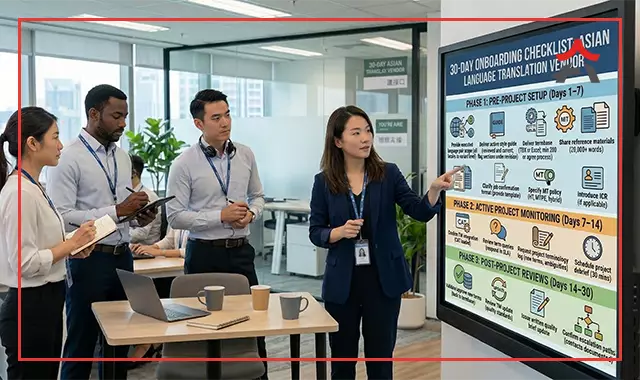
5. The First 30 Days: A Practical Delivery Checklist
 The inputs described in this article are not aspirational. They are operational prerequisites for a production relationship that performs. The following checklist organizes them by delivery timing within the first 30-day onboarding window.
Before Project 1 Begins (Days 1–7)
- Provide executed language pair scope: all target locales specified to regional variant level
- Deliver active style guide: reviewed and confirmed as current; flag any sections under revision
- Deliver termbase in TBX or structured Excel format: minimum 200 entries for established programs; agree on extraction process for new programs
- Share reference materials: 20,000+ words of validated translated content in target language(s)
- Clarify job confirmation format: provide a template or specify which fields are mandatory in every project release
- Specify MT policy: human translation, MTPE, or hybrid; if MTPE, specify the engine and output quality level expected
- Introduce the ICR (if applicable): name, role, authority level, and preferred feedback format
During Project 1 (Days 7–14)
- Confirm TM integration: verify the production partner has received and loaded your TM into their CAT environment
- Review any term queries raised by the production team: respond within the agreed SLA; unresolved queries produce unvalidated term choices
- Request a terminology log from the first project: a record of all new terms encountered, proposed translations, and any flagged ambiguities
- Schedule a project debrief: 30 minutes post-delivery to review any quality findings, process friction points, and scope clarifications
After Project 1, Before Project 2 (Days 14–30)
- Validate and approve new terms from the terminology log: feed them back into the termbase
- Review TM update: confirm the production team’s post-project TM matches your quality standards before it is used for future leverage calculations
- Issue a written quality brief update if any unexpected issues emerged in Project 1: do not rely on verbal feedback; written instructions travel through the production team’s processes more reliably
- Confirm escalation paths: who on your side approves urgent style decisions? Who resolves ICR override conflicts? Document these contacts and confirm with the production team
A production partner with a system cannot perform without inputs. The quality of those inputs determines the ceiling of what is achievable, regardless of the partner’s capability. The first 30 days are not a warm-up period. They are the period when defaults are established, TMs are seeded, and the quality parameters that will govern every subsequent project are set – implicitly or explicitly. Set them explicitly.
Conclusion: The Relationship Starts with the Brief
Production partners who work with Asian languages operate in an environment of significant linguistic complexity, high terminology density, and limited margin for early-stage ambiguity. The structural distance between source and target languages means that bad defaults compound quickly, and the cost of correcting them scales with the size of the TM and the depth of the legacy content pool.
The LSP project manager who provides a structured onboarding brief e.g. complete style guide, actionable termbase, regional variant clarity, quality specifications tied to observable outcomes, and a defined ICR relationship, does not just make the production partner’s work easier. They make good work possible.
The LSP project manager who provides nothing and expects professional defaults to deliver professional results will spend the back half of every project cycle in revision, re-review, and uncomfortable conversations about why the output does not match expectations that were never specified.
About 1-StopAsia
1-StopAsia is a specialist Asian language service provider with 25 years of experience offering end-to-end translation, localization, DTP, and linguistic QA services across the full range of Asian language pairs. Our production systems are built for clients who bring structured inputs, and our onboarding process is designed to help clients who are still building those inputs get there faster.
Languages: Japanese, Simplified Chinese, Traditional Chinese (TW/HK), Korean, Thai, Vietnamese, Indonesian, Malay, Tagalog, Burmese, Khmer, Lao, Mongolian, and more.