AI Overview
| Category | Summary |
| Topic | Japanese Medical Localization Quality Standards |
| Purpose | A practitioner guide for translators, reviewers, and QA leads working on Japanese medical content. Defines quality standards applicable when no client style guide is provided. |
| Key Insight | Japanese medical content requires three quality layers that generic frameworks miss: regulatory register calibration, domain-specific honorific conventions, and controlled katakana standardization for foreign medical terms. |
| Best Use Case | Pharmaceutical labeling, IFUs, clinical protocols, patient-facing materials, medical device documentation — in the absence of client-defined quality criteria. |
| Risk Warning | Applying general Japanese language rules to medical content without domain adaptation creates compliance risk and erodes credibility with Japanese medical professionals, even when the translation is linguistically accurate. |
| Pro Tip | Regulatory register (規制文体) is non-negotiable in submission documents. Confirm document type before assigning register level — IFU ≠ patient leaflet ≠ clinical protocol. |
1. Introduction
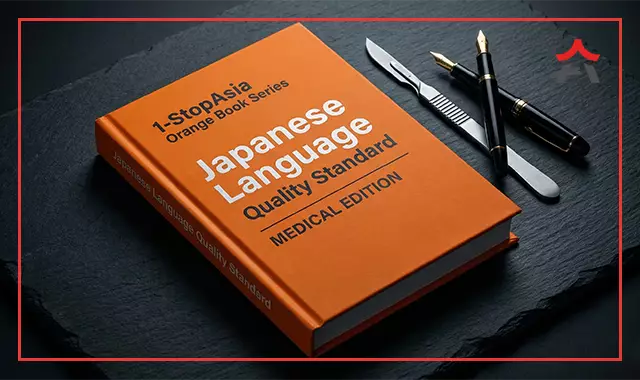
This guide is part of the 1-StopAsia Orange Book Series. It documents the quality standards applied by our Japanese linguistic and medical QA teams when working on medical content for which no client-defined style guide exists.
Medical Japanese occupies a distinct register that differs from both general business Japanese and technical Japanese. A translator with native Japanese fluency and general domain expertise will still produce substandard medical content without explicit training in the conventions documented here.
This document is organized into five sections:
- Regulatory Register: the mandatory style conventions for different medical document types
- Honorific and Person Reference: how to refer to patients, physicians, and institutions correctly by document type
- Katakana Standardization: the 1-StopAsia standard for foreign medical terminology rendered in katakana
- Medical Terminology Conventions: specific rules for high-frequency terms that cause consistent errors
- Punctuation, Format, and Numbers: Japanese-specific formatting rules for medical content
2. Regulatory Register (規制文体)
The single most common quality failure in Japanese medical localization is applying the wrong register to a document type. Japanese medical documents are not all written in the same style. Each document type has a defined register that Japanese regulatory professionals and medical practitioners expect and deviation is not a stylistic choice, it is an error.
2.1 Document Type Register Matrix
Apply the following register classification before beginning any translation:
| Document Type | Register | Form (文体) | Notes |
|---|---|---|---|
| Regulatory submission (CTD, PMDA) | Formal regulatory (規制語) | である調 (Da-aru) | Non-negotiable. No deviations. |
| Instructions for Use (IFU / 取扱説明書) | Technical formal | ます調 (Masu) or mixed | Imperative constructions are common. |
| Clinical trial protocol | Formal academic (学術語) | である調 | Passive voice preferred in procedures. |
| Package insert (添付文書) | Formal regulatory | である調 | PMDA template language must be followed. |
| Patient-facing leaflet | Polite accessible (丁寧語) | ます調 | Avoid technical jargon. Plain language. |
| Medical device manual | Technical polite | ます調 | Instructional imperative for procedures. |
| Healthcare professional communication | Professional polite (敬語) | ます調 + keigo | See Section 3 for honorific detail. |
| Adverse event / complaint report | Formal regulatory | である調 | Factual, passive, no evaluative language. |
2.2 Register Rules — Regulatory Documents
[MR001] Active vs. Passive Voice in Regulatory Submissions
In regulatory submissions, procedures and findings are described in the passive voice. Active construction is standard in English medical writing but reads as inappropriate in Japanese regulatory context.
| Source (English) | ✗ Incorrect | ✓ Correct | Rationale |
|---|---|---|---|
| We administered the drug at 10mg/kg. | 私たちは薬剤を10mg/kgで投与した。 | 薬剤を10mg/kgで投与した。/ 薬剤は10mg/kgで投与された。 | Subject ‘we’ dropped. Passive preferred in procedural description. |
| The investigator assessed the response. | 治験責任医師が反応を評価した。 | 治験責任医師により反応が評価された。 | Passive construction aligns with PMDA document conventions. |
[MR002] Non-Assertive Language in Safety Sections
Safety sections in package inserts and IFUs must use non-assertive language conventions (非断定表現). Absolute statements are avoided unless supported by clinical data in the source.
| Source (English) | ✗ Incorrect | ✓ Correct | Rationale |
|---|---|---|---|
| This drug causes liver damage. | この薬剤は肝臓障害を引き起こす。 | この薬剤は肝臓障害を引き起こす可能性がある。/ 肝機能障害があらわれることがある。 | Absolute causation language avoided without clinical data qualifier. |
| Do not use in patients with renal impairment. | 腎機能障害のある患者には使用する。 | 腎機能障害のある患者には使用しないこと。 | ‘こと’ construction for prohibitions in regulatory documents. |
[MR003] Prohibition and Instruction Constructions
Japanese medical regulatory documents use specific grammatical constructions for prohibitions, instructions, and warnings. These constructions are fixed — variation is not appropriate.
| Intent | Construction | Example | Document context |
|---|---|---|---|
| Prohibition | 〜ないこと / 〜してはならない | 直射日光を避けること | IFU, package insert |
| Instruction | 〜すること / 〜してください | 冷所保存すること | IFU formal / patient leaflet |
| Warning | 〜のおそれがある / 〜に注意すること | 過量投与のおそれがある | Package insert, warnings section |
| Contraindication | 〜患者には投与しないこと | 本剤に過敏症の患者には投与しないこと | Package insert, contraindications |
3. Honorifics and Person Reference
Person reference in Japanese medical content is not a stylistic decision. The way patients, physicians, and institutions are referred to is determined by document type, intended audience, and the relationship implied by the content. Errors here are visible to any Japanese medical professional even when the underlying translation is otherwise accurate.
3.1 Patient Reference
[HP001] Patient Reference by Document Type
The term used to refer to the patient varies by document type. Using the wrong patient reference term is a reliable indicator of non-specialist translation.
| Document Type | ✗ Avoid | ✓ Correct term | Rationale |
|---|---|---|---|
| Regulatory submission (CTD) | 患者さん | 患者 | さん suffix is inappropriate in formal regulatory/academic context. |
| Package insert (添付文書) | 患者さん | 患者 | Package inserts follow regulatory language convention. |
| Patient-facing leaflet | 患者 | 患者さん / 皆様 | Direct patient communication requires polite form. 患者 alone reads as clinical/cold. |
| HCP communication (physician letter) | 患者さん | 患者 | Physician-to-physician register uses clinical term without honorific. |
| Informed consent form | 患者 | 患者さん / あなた | Consent forms address the patient directly. Polite form required. |
[HP002] Second Person Reference (YOU)
English medical content uses ‘you’ extensively. Japanese medical documents handle second-person reference differently by document type. Do not translate ‘you’ mechanically.
| Source (English) | ✗ Incorrect | ✓ Correct | Rationale |
|---|---|---|---|
| If you experience side effects, contact your physician. | あなたが副作用を経験した場合、あなたの医師に連絡してください。 | 副作用が現れた場合は、担当医師にご相談ください。 | あなた dropped. Passive construction and ご〜ください honorific applied for patient-facing content. |
| You should not drive after taking this medication. | あなたはこの薬を飲んだ後に運転してはいけません。 | 本剤服用後は自動車の運転を避けること。 | Regulatory instruction construction for IFU context. No personal pronoun. |
3.2 Physician and Institutional Reference
 [HP003] Physician Reference
How physicians are referenced depends on whether the document is addressed to them, about them, or for patients reading about them.
| Context | Correct reference | Notes |
|---|---|---|
| Regulatory document (clinical) | 治験責任医師 / 治験担当医師 | Specific titles required by PMDA. Do not substitute with 医師 alone. |
| Package insert instruction to prescriber | 医師 | General physician reference in prescriber instructions. |
| Patient leaflet — referring to physician | 担当の医師 / 主治医 | 患者 audience requires accessible, humanized physician reference. |
| HCP letter — addressing physician directly | 先生 (in greeting only) | 先生 used in salutation. Body text uses 医師 or role title. |
4. Katakana Standardization for Medical Terms
Foreign medical terminology in Japanese is rendered in katakana. Unlike general consumer content where katakana variants are tolerated, medical katakana has established conventions in regulatory and clinical use. Variance from established medical katakana signals non-specialist translation immediately to Japanese medical professionals and regulatory reviewers.
The 1-StopAsia standard applies the following hierarchy when selecting katakana renderings for medical terms:
- PMDA-approved term in existing Japanese labeling (highest authority)
- Japanese Pharmacopoeia (日本薬局方) for pharmaceutical substances
- Japan Society term conventions for disease names and procedures
- High-frequency search result convention (established medical usage)
- JIS standard for general katakana elongation rules (baseline only)
4.1 Pharmaceutical Substance Names
[KT001] INN (International Nonproprietary Names) in Katakana
Drug substance names (INNs) have established Japanese katakana equivalents. Do not create new renderings from phonetic rules — use the established term.
| Source (English) | ✗ Incorrect | ✓ Correct | Rationale |
|---|---|---|---|
| Metformin | メトフォルミン (phonetic) | メトホルミン | Established PMDA/JP term. ‘fo’ rendered as ‘ho’ by convention. |
| Warfarin | ウォーファリン | ワルファリン | Japanese Pharmacopoeia standard. Do not apply general katakana phonetics. |
| Adrenaline | アドレナライン | アドレナリン | JP established term. Elongation applied differently than general rule. |
| Acetaminophen | アセタミノフェン | アセトアミノフェン | PMDA preferred term. Additional syllable in medical convention. |
4.2 Disease and Condition Names
[KT002] Disease Name Katakana Conventions
Disease names in Japanese have mixed conventions — some are written in kanji (漢字), some in katakana, some in both. The choice is not arbitrary and is established by Japan Society convention and regulatory precedent.
| Source (English) | ✗ Incorrect | ✓ Correct | Rationale |
|---|---|---|---|
| Alzheimer’s disease | アルツハイマー病 alone (in formal docs) | アルツハイマー型認知症 (regulatory) / アルツハイマー病 (general) | PMDA prefers specific diagnostic term in regulatory context. |
| Diabetes mellitus type 2 | 2型糖尿病 only | 2型糖尿病(T2DM) | English abbreviation added in clinical documents per regulatory convention. |
| Myocardial infarction | 心臓発作 (patient-facing OK) | 心筋梗塞 (regulatory/clinical) | 心臓発作 is colloquial — acceptable in patient leaflets, not in clinical/regulatory docs. |
| Hypertension | ハイパーテンション | 高血圧症 / 高血圧 | Katakana avoided for disease names with established kanji equivalents. |
4.3 Procedure and Device Terms
[KT003] Surgical and Diagnostic Procedure Katakana
Procedure names in Japanese regulatory and clinical content follow conventions established in Japanese medical education and PMDA submissions. The following represent high-frequency errors in non-specialist Japanese medical translation.
| Source (English) | ✗ Incorrect | ✓ Correct | Rationale |
|---|---|---|---|
| Magnetic Resonance Imaging (MRI) | マグネティックレゾナンスイメージング | 磁気共鳴画像 (MRI) | Acronym retained in parentheses. Japanese term preferred in clinical docs. |
| Computed Tomography (CT) | コンピュータ断層撮影 | コンピューター断層撮影 (CT) / CT検査 | Elongation on コンピューター in current medical usage. CT acronym retained. |
| Catheter | キャセター | カテーテル | Established medical katakana. Phonetic rendering is incorrect. |
| Stent | ステント alone in IFU instructions | ステント留置術 (procedure) / ステント (device reference) | Distinguish device from procedure in regulatory context. |
5. Medical Terminology Conventions
This section documents high-frequency terminology errors in Japanese medical translation. These are not edge cases — they appear consistently across projects handled by non-specialist translators and represent the most common quality failures caught by 1-StopAsia medical QA review.
5.1 Adverse Event Terminology
[TM001] Adverse Event vs. Adverse Drug Reaction
These terms have distinct definitions in Japanese regulatory context and must not be used interchangeably.
| English | Incorrect | Correct | Definition distinction |
|---|---|---|---|
| Adverse event (AE) | 副作用 | 有害事象 | Any untoward event, regardless of causality. Not equivalent to ADR. |
| Adverse drug reaction (ADR) | 有害事象 | 副作用 / 薬物有害反応 | Causally linked to drug. 副作用 is the established PMDA term. |
| Serious adverse event (SAE) | 重大な副作用 | 重篤な有害事象 | 重篤 (serious/life-threatening) is the regulatory standard. 重大 means ‘important’ not ‘serious’. |
| Side effect | 有害事象 | 副作用 (patient-facing) / 有害反応 (clinical) | Patient leaflets use 副作用. Do not use 有害事象 in patient communication. |
[TM002] Frequency Terms for Adverse Events
Japanese package inserts use specific frequency descriptors defined by PMDA. These must be applied exactly. Do not translate frequency terms using general Japanese equivalents.
| Frequency | Rate | PMDA term (添付文書) | Avoid |
|---|---|---|---|
| Very common | ≥1/10 | 非常に多い / 頻度不明の場合:頻度不明 | とても多い、非常に頻繁 |
| Common | ≥1/100 to <1/10 | 〔頻度〕% | よくある、一般的な |
| Uncommon | ≥1/1000 to <1/100 | 〔頻度〕% | まれな、少ない |
| Rare | ≥1/10,000 to <1/1,000 | 〔頻度〕% | 稀な、非常にまれ |
| Unknown frequency | Cannot estimate | 頻度不明 | 不明、わからない |
5.2 Dosing and Administration Terminology
[TM003] Route of Administration
Administration route terms in Japanese regulatory documents are standardized. Non-standard renderings trigger queries from PMDA reviewers.
| Source (English) | ✗ Incorrect | ✓ Correct | Rationale |
|---|---|---|---|
| Oral administration | 口からの投与 / 飲み薬 | 経口投与 | 経口投与 is the regulatory standard. Patient-facing documents may use ‘服用’ or ‘飲む’. |
| Intravenous injection | 静脈への注射 | 静脈内注射 / 静注 | Abbreviation 静注 acceptable in clinical shorthand. Full term in regulatory docs. |
| Subcutaneous injection | 皮下への注射 | 皮下注射 / 皮下投与 | Both acceptable in regulatory. 皮下注 in shorthand. |
| Topical application | 局所的な使用 | 局所投与 / 外用 | 外用 for dermatological products. 局所投与 broader regulatory term. |
| Once daily | 一日に一回 / 1日1回/日 | 1日1回 | PMDA standard format. Kanji numerals not used in dosage instructions. |
[TM004] Dosage Form Terminology
Pharmaceutical dosage forms have established Japanese terms. Colloquial equivalents are not acceptable in regulatory or IFU documents.
| Dosage form | Avoid | Correct term | Notes |
|---|---|---|---|
| Tablet | タブレット (general) | 錠剤 / 錠 | 錠 abbreviation in dosing instructions. 錠剤 in descriptions. |
| Injection | 注射薬 | 注射剤 | 注射剤 is the regulatory standard dosage form term. |
| Ointment | クリーム (specific type) | 軟膏剤 (ointment) / クリーム剤 (cream) | Ointment and cream are distinct forms with different regulatory terms. |
| Oral solution | 飲み薬 | 経口液剤 / 内服液剤 | 飲み薬 is colloquial and patient-facing only. |
6. Punctuation, Format, and Numbers in Medical Context
Formatting rules from the general 1-StopAsia Japanese Orange Book apply as baseline. The following medical-specific rules take precedence where they differ.
6.1 Numbers and Units in Medical Documents
[FM001] Numeric Format for Dosage and Measurements
Japanese medical documents use Arabic numerals for all dosage quantities, measurements, and clinical values. Kanji numerals are not used in clinical or regulatory content.
| Source (English) | ✗ Incorrect | ✓ Correct | Rationale |
|---|---|---|---|
| 10 milligrams | 十ミリグラム / 10 mg(space before unit) | 10mg(no space) | No space between numeral and unit in Japanese medical regulatory format. |
| 5.5 micrograms/kg/day | 5.5 μg/kg/日 | 5.5μg/kg/日 | Slash not fullwidth slash (/). Use standard forward slash (/). |
| Once every two weeks | 1回/ 2週 | 2週間に1回 | Frequency expressed as interval then count in Japanese regulatory convention. |
| Body weight 70 kg | 体重70 kg | 体重70kg | No space. Unit immediately follows numeral in medical Japanese. |
[FM002] Percentage and Ratio Format
| Source (English) | ✗ Incorrect | ✓ Correct | Rationale |
|---|---|---|---|
| Incidence rate of 3.5% | 発現率3.5 %(space) | 発現率3.5% | No space before % in Japanese medical documents. |
| 1 in 10 patients | 10人中1人 or 10分の1 | 10例中1例 / 10.0% | 例 preferred over 人 in clinical data expression. Percentage where data supports. |
6.2 Brackets and Parentheses in Medical Content
[FM003] Parenthetical Use for Abbreviations and Cross-References
In Japanese medical regulatory documents, parentheses follow specific conventions for abbreviations, cross-references, and supplementary information.
| Source (English) | ✗ Incorrect | ✓ Correct | Rationale |
|---|---|---|---|
| Adverse events (AEs) were recorded. | 有害事象(AEs)を記録した。 | 有害事象(AE)を記録した。 | Japanese does not pluralize. AE not AEs. Parenthetical abbreviation retained in Latin characters. |
| See Section 4.2 (Contraindications) | セクション4.2(禁忌)を参照 | 「4.2 禁忌」の項を参照のこと。 | Section reference convention in PMDA documents. の項 construction used. |
7. QA Checklist — Japanese Medical
 Apply this checklist before submitting any Japanese medical translation for review. Items marked [REGULATORY] are non-negotiable for PMDA submission documents.
Register and Style
- [REGULATORY] Confirmed document type and applied correct register (である調 vs ます調)
- [REGULATORY] Passive construction used throughout regulatory submission procedures
- Non-assertive language applied in safety and warning sections
- Prohibition and instruction constructions confirmed against Section 2.3 matrix
Person Reference
- Patient reference confirmed for document type (患者 vs 患者さん vs あなた)
- Physician reference confirmed for document context
- [REGULATORY] Clinical trial physician titles confirmed (治験責任医師 / 治験担当医師)
- Second person ‘you’ handled correctly — not mechanically translated as あなた
Terminology
- [REGULATORY] AE / ADR / SAE distinction confirmed — not interchanged
- Frequency terms confirmed against PMDA standard where applicable
- Route of administration terms confirmed against Section 5.3
- Dosage form terms confirmed — regulatory vs patient-facing variants applied correctly
Katakana
- [REGULATORY] Drug substance names verified against JP or PMDA approved term
- Disease names — kanji vs katakana confirmed against established medical use
- Procedure and device katakana confirmed — not generated from phonetic rules alone
- Elongation rules verified for medical terms (do not apply general JIS rules to medical katakana)
Format and Numbers
- Arabic numerals used throughout — no kanji numerals in clinical/regulatory content
- No space between numeral and unit (mg, kg, μg etc.)
- Percentage format confirmed — no space before %
- Parenthetical abbreviations confirmed — no plural ‘s’ in Latin abbreviations
- Section cross-reference format confirmed for document type
8. About This Guide
This guide is part of the 1-StopAsia Orange Book Series, which is our published quality standards for Asian language content across core domains. The Orange Books document the standards our in-house linguistic teams apply when clients have not defined their own quality criteria.
We publish them because we believe quality in localization should be transparent, not assumed. An LSP or enterprise buyer working with 1-StopAsia on Japanese medical content should be able to understand exactly what standard their content will be held to and why.
Scope and Limitations
This guide covers general Japanese medical localization quality standards applicable across pharmaceutical, medical device, and clinical document types. It does not substitute for:
- Client-provided style guides, glossaries, or TM (which always take precedence)
- PMDA regulatory guidance documents (referenced here but not reproduced)
- Japan Pharmacopoeia monographs for specific substance naming
- Device-specific regulatory requirements under the PMDA Medical Device framework
Updates and Feedback
This guide is reviewed annually by the 1-StopAsia Japanese medical QA team. Feedback from clients, reviewers, and project managers is incorporated into each revision. If you identify a case not covered by this guide or believe a standard documented here requires revision, contact your 1-StopAsia project manager.
Related Orange Book Editions
- Vietnamese Orange Book: Marketing Edition (published)
- Chinese Simplified Orange Book: Financial Edition (published)
- Japanese Orange Book: General Business Edition
- Japanese Orange Book: Automotive Edition (forthcoming)
- Japanese Orange Book: Financial Edition (forthcoming)