AI Overview
| Category | Summary |
| Topic | A rolling multilingual pipeline for patient education and clinical content |
| Purpose | To explain how per-language workflows, dedicated linguists, and update verification supported recurring clinical translation waves. |
| Key Insight | Per-language TEP chains and change verification kept 25 language pairs moving without requiring each update to restart production. |
| Best Use Case | Healthcare content teams managing recurring patient-education and clinical-document updates across multiple Asian languages. |
| Risk Warning | Allowing one language or version update to hold the full document set can disrupt recurring delivery schedules. |
| Pro Tip | Assign each language its own production chain and verify changed sections against existing translated files. |
A U.S. patient-education content provider needed clinical and educational materials translated into Asian languages on a rolling basis.
Between July and August 2026, we produced 69 jobs across 25 language pairs, including languages often handled as special requests: Odia, Bengali, Urdu, Kannada, Malayalam, Marathi, and Gujarati.
The individual jobs were not particularly large. The challenge was keeping a changing mix of languages moving through the same production rhythm, while also handling document updates and language-specific requirements.
The Client and the Production Challenge
The client produces patient-facing content, including education materials, study-related documents, and protocol updates. The work arrives in waves, triggered by document version updates, new studies, and regulatory review cycles rather than as one large annual project.
A typical wave contains around 2,500 to 3,000 words per language. That volume can be completed within two days in a single language. The complexity comes from the breadth of the language set.
A single dispatch could include Simplified Chinese, Traditional Chinese, Hong Kong Chinese, Japanese, Korean, Thai, Vietnamese, Indonesian, Malay, and Hindi, with additional languages rotating in as the content set evolved. Some, including Odia, Malayalam, and Marathi, required specialist resources outside the typical generalist vendor pool.
Then there were the updates.
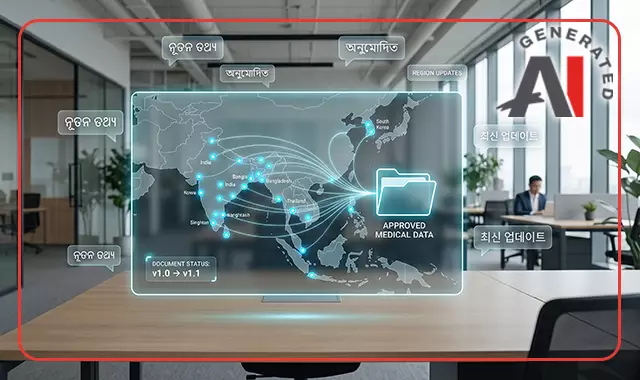
When a source document moved from version 1.0 to 1.1, the same material needed to be updated across the translated files. The changed sections had to be identified and reworked, while unaffected text remained untouched. A delay in one language could hold up an entire document set.
Keeping the Pipeline Moving
The relationship was managed through a single senior project manager on our side, working directly with the client’s project team. Behind that point of contact was an extended production team of around 60 linguists: in-house linguists for the core language set and one dedicated vendor for each rare language.
Production followed a translation, editing, and proofreading (TEP) workflow, with verification-of-changes passes added when documents were updated.
Several parts of the workflow helped keep the different language streams moving independently.
Per-language dispatch. Each wave was divided into individual language TEP chains, so one language did not determine the pace of the entire set. On one July day, 18 jobs were dispatched across the language set, with roughly 3,000 words per language and its own deadline.
Two-business-day turnaround. A typical wave of around 2,500 words per language moved from dispatch to delivery within two business days. On one multi-language job agreed at three days, the full set was delivered in two.
Update verification. When a source moved from version 1.0 to 1.1, only the changed sections were reworked in track-changes mode, with instructions not to touch unaffected text. This avoided unnecessary re-translation while keeping terminology consistent across versions.
Language-specific requirements. Some content required additional handling based on the target language and receiving institution. For patient-facing Thai content, for example, the team needed to account for Thai numerals and formal Thai formatting for ethics-committee review.
These requirements were handled within the production process rather than treated as separate exceptions.
That became particularly clear when the client’s reviewer raised a question after one delivery. The linguist who had worked on the file explained why the language had been formatted that way. The client’s response was a thank-you.
Then the next wave continued.
The Numbers Behind the Program
 Over eight weeks, the pipeline delivered:
- 69 jobs
- 25 language pairs
- 90,000+ words translated and edited
- Around 60 linguists supporting production
- 1 to 3 multi-language waves per month
- Approximately 2 business days as the typical turnaround
Update verification ran alongside new translation work, allowing version changes to be handled within the existing files without disrupting the regular production rhythm.
What Makes a Rolling Pipeline Work
The difficulty in a program like this is not necessarily the volume of any individual job. Around 2,500 to 3,000 words in one language is manageable.
The test comes from everything that happens around that volume.
A new language can enter the program mid-cycle. A document can return with a new version. A reviewer can raise a question about a language-specific convention. A rare language can require a dedicated resource rather than an immediately available linguist.
For a rolling multilingual program, those situations need to be absorbed without turning each one into a new production problem.
In this case, the language mix could expand without a recruiting scramble. Rare languages had dedicated resources, core languages were supported by the in-house team, and version updates were handled directly against existing translated files.
The result was a pipeline that could move 25 language pairs through recurring waves without making every new language or document version feel like a new project.
If your organization produces multilingual patient education or clinical content, see how we support these programs through our healthcare translation services.