AI Overview
| Category | Summary |
| Topic | How election materials translation protects voting rights and increases participation for diverse Asian American voters in the US |
| Purpose | To highlight the importance of accurate, culturally sensitive, and well-formatted election material translations to ensure equitable voting access for Asian Americans with limited English proficiency |
| Key Insight | Effective election translation requires more than literal word conversion – native linguistic and cultural expertise, consistent terminology, and integrated multilingual desktop publishing are vital to prevent voter confusion and disenfranchisement. |
| Best Use Case | Government agencies, civic organizations, and localization providers working on election materials, ballots, and voter guides for linguistically diverse Asian American populations in Section 203 covered jurisdictions and beyond |
| Risk Warning | Failing to address quality, native review, formatting, and staffing in election translation workflows can lead to voter confusion, disenfranchisement, and legal challenges, mere document translation is insufficient. |
| Pro Tip | Adopt a single-partner, end-to-end workflow that integrates native linguists, independent review, consistent terminology, and multilingual desktop publishing to deliver accessible, culturally appropriate, and precisely formatted election materials. |
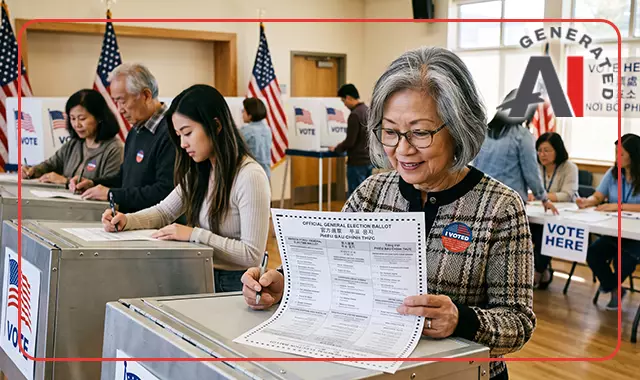
On November 3, 2026, millions of Americans will walk into polling places and find a ballot they cannot fully read. Not because the print is too small, but because the language on it isn’t theirs. Fifteen million Asian Americans were eligible to vote in the last presidential cycle, a number that has climbed faster than that of any other racial group since 2000, and a meaningful share of that population still struggles with English-only voting materials. That gap sits at the intersection of civil rights law, federal politics, and something far more practical: whether a translated sentence on a sample ballot actually makes sense to the person reading it. For localization companies and public agencies alike, translation of election materials is no longer a niche compliance task. It is one of the clearest tests of whether the language services industry can deliver accuracy under real pressure.
Asian Voters in the US Are Growing Faster Than the System Serving Them
Asian voters in the US are anything but a single audience. The community speaks dozens of languages across dramatically different levels of English proficiency, and that diversity is precisely what makes election communication so difficult to get right. Registration growth reflects how quickly this electorate is expanding. Between January and June of 2024, Asian American, Native Hawaiian, and Pacific Islander voter registration grew faster than that of any other demographic group in the country, more than double the overall average increase among new registrants over the same period. In 2020, Asian American turnout in battleground states such as Arizona, Georgia, Nevada, North Carolina, and Pennsylvania exceeded the final margin of victory. A voter who cannot understand the instructions on a mail-in ballot is not a rounding error in states decided by a few thousand votes.
Why Limited English Proficiency Still Determines Who Can Vote
Limited English proficiency remains the practical barrier behind these numbers. Federal data cited by members of the Congressional Asian Pacific American Caucus puts limited English proficiency at roughly 32 percent among Asian Americans nationally, well above the rate for the general population. In Massachusetts, close to 66 percent of Asian American adults speak a language other than English at home, and about a third of them qualify as limited English proficient. When ballot instructions, polling place notices, or absentee procedures exist only in English, a substantial share of eligible voters is left guessing at a process that determines their representation.
Government Translation Services and the Legal Patchwork Behind Ballot Access
Government translation services for elections in the US do not rest on one uniform rule. Section 203 of the Voting Rights Act requires specific counties and states to provide voting materials in designated minority languages once census data shows a sufficiently large population with limited English proficiency, with coverage reassessed every five years. Kings, New York, and Queens counties in New York must provide Chinese-language materials, and Queens also covers Bangladeshi and Asian Indian communities. Harris and Dallas counties in Texas must provide Vietnamese materials, and Harris County must additionally cover Chinese, including Taiwanese.
That legal foundation shifted in March 2025, when Executive Order 14224 designated English as the official language of the United States and revoked the twenty-five-year-old order requiring federal agencies to actively support limited English proficient residents. The order does not eliminate obligations that already exist under Title VI of the Civil Rights Act, the Affordable Care Act, or the Stafford Act, but it does give agencies discretion they did not previously have. Several members of Congress have since pressed federal departments to confirm that translation support for voters will continue without interruption. New York, for instance, has confirmed its own Language Access Law is unaffected by the federal order and has committed new funding to the program in its 2026 budget.
Translation Services for Government Shouldn’t Stop at Literal Word Conversion
Translation services for government agencies working on election content carry a burden that commercial translation rarely does, since a single ambiguous phrase can change how a citizen exercises a constitutional right. A term that reads clearly in Mandarin may confuse a Cantonese-speaking voter, and a phrase translated correctly into Vietnamese can still fail if its register is too formal for a voter with limited literacy in their own language. This is why sensitive government and civic content needs native linguists working in their language and region of origin, supported by independent review rather than a single translator’s judgment, with terminology locked before translation begins so that terms like “provisional ballot” or “early voting” stay consistent across every language version a jurisdiction publishes.
Voting Information Guides Translation: Getting Ballot Language Right
 Voting information guides translation involves more than converting a document from English into another language. Ballots, sample ballots, and voter guides often need to preserve exact formatting so that a translated version lines up with the numbering and layout election officials use to certify it. This challenge connects directly to broader shifts in how Asian diaspora languages are reshaping US localization: regional dialect variation, uneven literacy, and changing federal guidance all apply to election content, only with far less room for error.
Multilingual Desktop Publishing: The Layer Multilingual DTP Services Add to Ballots
Multilingual desktop publishing rarely comes up in conversations about election access, yet it decides whether a translated ballot is usable at all. Asian scripts expand, contract, or restructure differently than English text does. A Korean or Thai translation can run considerably longer than its English source, while Chinese and Japanese characters follow entirely different line-break rules. Without multilingual DTP services built into the workflow, a translated voter guide can end up with cut-off text, misaligned columns, or oversized fonts. Election administrators rarely have the bandwidth to catch these issues before printing deadlines, which is exactly why formatting needs to sit inside the same workflow as translation rather than being handled separately.
A Case Study in Election Translation Services: Lessons from Section 203 Jurisdictions
Election translation services tend to fail in specific, well-documented ways. A 2022 civic engagement report on New York City found that during the 2021 primary, multiple polling sites required to provide Section 203 language assistance experienced translator shortages. Interpreter tables were set up as required, but in several cases the interpreters never arrived, leaving voters with limited English proficiency to navigate ballots and procedures largely on their own. The report’s authors recommended structured Election Day readiness audits specifically to prevent this outcome from repeating.
That example points to the core weakness in how many jurisdictions approach language access. Covered counties often satisfy the letter of Section 203 by producing translated documents, while staffing, quality control, and formatting get treated as separate problems handled by separate vendors. A single-partner model, where translation, terminology management, native-speaker review, and desktop publishing happen inside one coordinated workflow, closes exactly the kind of gap that left New York City voters without interpreters in 2021. At 1-StopAsia, this is the model our team applies to sensitive, high-stakes content: the goal is not simply a translated document delivered on time, but a formatted, reviewed final product a voter can actually use at the polling table.
Election Materials Translation and the Future of Asian American Political Participation
Asian American political participation is growing faster than the infrastructure built to support it. Registration and turnout are both up, and the eligible voter population keeps expanding, even as the legal environment around language access shifts, sometimes reducing federal support rather than expanding it. Accurate, well-formatted election materials translation remains one of the few levers that consistently improves voter confidence and turnout among limited English proficient communities, regardless of how federal policy moves in a given year. Organizations that treat this work as a specialized discipline, rather than a generic translation task, are the ones keeping pace with a voting population that grows more linguistically diverse every cycle.
Key Takeaways
- Election materials translation directly affects turnout among Asian voters in the US, whose eligible voter base and registration growth are both outpacing the national average.
- Government translation services for elections operate under a patchwork of Section 203 coverage, state law, and a shifting federal policy environment following Executive Order 14224.
- Voting information guides translation and multilingual desktop publishing must be handled together, since formatting failures can undo the value of an otherwise accurate translation.
- Documented failures, like the 2021 NYC interpreter shortage, show that translation quality alone does not guarantee ballot access; staffing and workflow coordination matter just as much.
If your organization manages election, government, or other sensitive civic content that needs to reach Asian language communities accurately, contact 1-StopAsia to discuss a translation and desktop publishing workflow built for the stakes involved.