AI Overview
| Category | Summary |
| Topic | Optimizing short drama localization workflows to meet fast-paced international demand while maintaining cultural and linguistic quality |
| Purpose | To inform content owners, distributors, and platforms about the importance of early and efficient localization strategies that balance speed and quality for Chinese short dramas targeting Asian and global audiences |
| Key Insight | The success of short dramas internationally depends on exploiting a shrinking localization window where rapid delivery and cultural adaptation must coexist; AI can accelerate production, but human linguistic expertise is essential to preserve emotional impact and cultural authenticity. |
| Best Use Case | Streaming platforms, distributors, and localization managers seeking scalable, high-quality workflows to localize Chinese micro dramas rapidly for Southeast Asia, Japan, Korea, and other Asian markets |
| Risk Warning | Delays in localization can result in lost market momentum, piracy, and weakened brand control, while purely automated translations risk flattening character depth and alienating audiences due to cultural insensitivity or poor linguistic quality. |
| Pro Tip | Establish an integrated localization pipeline combining AI-assisted transcription and translation with native-linguist adaptation and market-specific cultural reviews early in the content acquisition process to create repeatable workflows and gain long-term competitive advantage. |
The global short drama market has reached an inflection point. Chinese micro dramas have moved from a niche digital format into a significant international entertainment category. The global micro drama market grew from RMB 1 billion in 2020 to RMB 60.4 billion in 2024, according to a 2026 industry overview, with the market forecast to reach RMB 271.2 billion by 2029. China’s overseas micro drama market is expanding alongside it.
That growth changes the localization equation.
For streaming platforms and distributors, the opportunity to introduce a Chinese short drama to a new audience increasingly depends on how quickly the content can become culturally and linguistically ready for that market.
This creates what we can call the short drama localization window: the period in which a title can be localized, released, promoted, and monetized while audience interest, platform momentum, and competitive advantage remain strong.
For the industry, the next 18 months could be especially important. The platforms that establish efficient localization workflows now will be better positioned as competition intensifies.
The Shrinking Localization Window
The traditional television localization cycle was built around relatively long production and distribution schedules. Short drama operates differently.
Episodes are frequently designed for mobile viewing, rapid consumption, and continuous cliffhangers. Production and distribution can move quickly, and international platforms can test content across markets without following the same release patterns associated with conventional television.
That creates pressure on every part of the localization process.
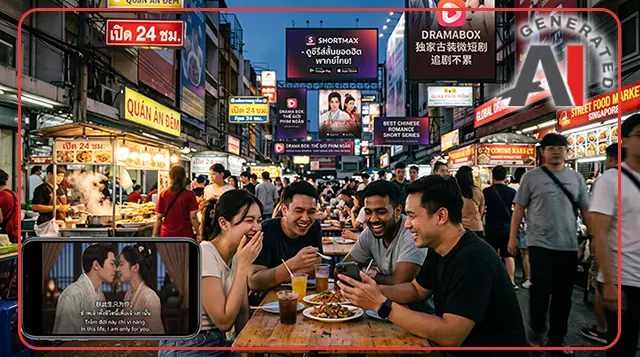
Chinese short drama platforms are competing aggressively for audiences across Southeast Asia and other international markets. In Southeast Asia, Chinese platforms such as DramaBox and ShortMax have become major players, while regional services including Singapore’s Viddsee and Thailand’s TrueVisions are also developing short-form drama offerings.
For localization managers, three forces are converging:
- More content: Producers are creating and exporting larger volumes of short-form drama.
- More platforms: International and regional streaming services are competing for the same audiences.
- Faster audience cycles: Social media trends, genres, actors, and story formats can gain or lose momentum quickly.
The consequence is straightforward. A localization workflow that takes too long can become a commercial bottleneck.
Missing the window can mean launching after competitors have already captured audience attention, separating a release from its marketing campaign, or allowing unofficial translations to reach viewers first.
Piracy adds another layer. When audiences cannot access an official localized version quickly, unofficial versions can fill the gap. The rights holder then loses more than immediate viewing revenue. They can lose control over terminology, character names, brand presentation, and the overall viewer experience.
Strategic Localization in a Tight Schedule
Fast delivery matters, but linguistic quality remains central to viewer retention.
Short drama leaves very little room for weak dialogue. A character may have only a few seconds to establish authority, flirtation, sarcasm, anger, or vulnerability. A literal translation can preserve the information while weakening the emotional effect.
That is where strategic video localization becomes important.
At 1-StopAsia, the workflow combines technology with native linguistic expertise. The company’s current AI-assisted multimedia process can support transcription, subtitle generation, timing, segmentation, and translation before human specialists review the output for phrasing, tone, cultural fit, terminology, and synchronization.
The principle is practical: let technology handle repetitive production work while experienced linguists make the decisions that affect how a story feels.
A high-volume workflow can include:
- Content preparation: Build terminology lists, character references, style guidelines, and market requirements before translation begins.
- AI-assisted processing: Accelerate transcription, first-pass translation, segmentation, and timecoding.
- Human adaptation: Native linguists refine dialogue, idioms, humor, relationships, and character voice.
- Subtitle QA: Check timing, reading speed, segmentation, formatting, and technical specifications.
- Cultural review: Examine whether references and expressions make sense to the target audience.
- Final validation: Confirm consistency across episodes and prepare files for platform delivery.
CAT tools also have an important role. They support terminology consistency, translation memory, collaboration, and production efficiency, particularly when a project contains many episodes or multiple languages. 1-StopAsia works across major CAT platforms and can adapt workflows to client requirements.
Singapore Shows Why Market Context Matters
Singapore is a useful example of why Asian localization cannot be treated as one regional checkbox.
The country’s multilingual media environment, sophisticated streaming audience, and position within Southeast Asia make it an important market for content distributors. At the same time, Singapore sits within a region where Chinese short drama platforms are already highly active.
A localization strategy therefore needs to consider more than language. Teams should evaluate audience expectations, platform requirements, cultural references, subtitle conventions, and the relationship between Singapore and neighboring Southeast Asian markets.
The same principle applies when prioritizing markets such as South Korea, Japan, and China. Each has distinct linguistic conventions and viewer expectations.
For Japanese, Korean, and Chinese subtitles, factors such as character density, spacing, reading pace, honorifics, and sentence structure can materially affect the viewing experience. 1-StopAsia’s video localization workflow specifically accounts for differences among Asian writing systems and viewing conventions.
A Practical Example: Speed Without Losing the Story
 One recent 1-StopAsia Chinese drama localization project illustrates why a hybrid model can work particularly well.
The production involved characters from different regions of China, including dialogue influenced by Northeastern Mandarin and culturally specific references. The challenge was familiar to anyone working on entertainment localization: the project required fast processing, but a straightforward automated translation would have flattened some of the character distinctions.
The team used AI-assisted processing during the initial stage to accelerate transcription and translation. Native linguistic specialists then handled dialogue adaptation, cultural review, regional-language validation, tone calibration, and final voiceover quality checks. According to 1-StopAsia’s project account, audience feedback highlighted natural dialogue flow, believable character voices, and stronger emotional engagement.
That workflow reflects a broader lesson for the short drama market.
AI can reduce the time required to move large volumes of content through production. Human specialists remain essential when the content depends on subtext, emotion, cultural context, and character identity.
The strongest approach is therefore rarely a choice between technology and linguists. It is a carefully controlled production pipeline that assigns each task to the right resource.
What the 18-Month Window Means in Practice
The 18-month timeframe should be viewed as a strategic planning horizon rather than a universal expiration date for every drama title. Some content will remain commercially relevant much longer. Other titles may have an opportunity measured in weeks because they depend heavily on current trends.
The important point is that localization needs to enter the content strategy earlier.
A platform preparing an international release should consider localization while evaluating acquisition opportunities, rather than waiting until the final stage of production.
They also create scalability. A well-designed workflow established for one short modern Chinese drama can become a repeatable framework for an entire content slate.
The Competitive Advantage Is Moving Upstream
The short drama market has already demonstrated that international demand exists. A useful example is our article about Zhang Linghe, you can read it here. The next challenge is building sustainable audience relationships.
Research examining ReelShort and DramaBox found different approaches to localized versus translated content, with localization associated with stronger initial retention in the study’s analysis and translated content supporting broader market penetration.
That distinction matters.
A translation can make a story understandable. Localization can help make the story feel relevant.
For a format built around emotional hooks and rapid episode-to-episode consumption, that difference can influence whether a viewer continues watching.
This is why the next 18 months should be treated as a period for building localization infrastructure, not simply rushing individual titles to market.
Platforms that establish terminology systems, trusted linguist networks, AI-assisted workflows, quality standards, and market-specific review processes now will have an operational advantage when content volumes increase.
Conclusion: The Window Is Open, but It Will Not Stay Wide
The short drama market is moving quickly. International revenue is growing, new platforms are entering the space, and Chinese short drama is reaching audiences far beyond its original market.
For content owners and distributors, localization has become part of that race.
The opportunity over the next 18 months is to build workflows capable of responding to demand without sacrificing the linguistic and cultural qualities that make drama compelling in the first place.
1-StopAsia combines Asian-language expertise, AI-assisted media localization, CAT-enabled workflows, subtitle production, cultural adaptation, and human quality control to support that objective. Its current multimedia workflow covers languages including Chinese, Japanese, Korean, Thai, and Vietnamese, with processes designed around timing, tone, segmentation, and market-specific requirements.
If you are planning a Chinese short drama release, expanding into Asian markets, or looking to shorten turnaround times across a growing content slate, contact 1-StopAsia to discuss your localization requirements and identify where technology, linguistic expertise, and market-specific adaptation can improve your release strategy.