AI Overview
| Category | Summary |
| Topic | Internal quality guidelines (The Orange Book) for Asian languages |
| Purpose | To establish a consistent operational baseline that resolves recurring linguistic decisions when client briefs are silent |
| Key Insight | Operational silence in Asian language production is routine and requires institutionalized “translation default decisions” built from accumulated production experience |
| Best Use Case | Ensuring consistent, high-quality Asian language localization for urgent projects or when comprehensive style guides are absent |
| Risk Warning | Relying on individual linguist improvisation when briefs are silent leads to inconsistency, unpredictable quality, and potential delays |
| Pro Tip | Ask your production partner: “What happens when my brief goes quiet?” to assess their operational readiness |
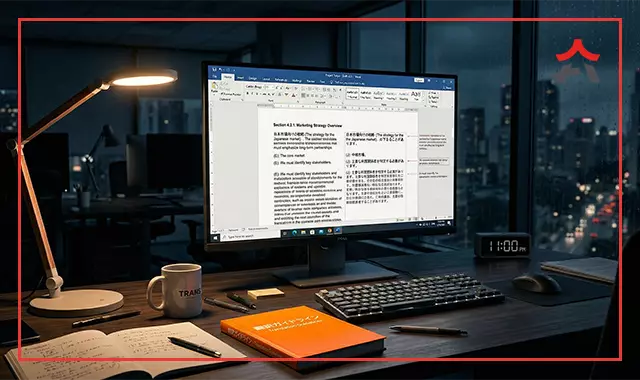
The file arrived at eleven at night. Japanese. Corporate communications. The client’s global style guide was thorough e.g. tone, voice, brand positioning, all clearly defined for English. It said nothing about the formality register in Japanese.
Desu/masu form? Plain form? Something hybrid for a digital interface? The guide wasn’t silent because the client was careless. It was written by people who had never needed to make that decision because in English, they hadn’t.
That moment, when the brief goes quiet at exactly the point where the work needs an answer, is a regular in Asian language production. It is the daily starting condition. The question is never whether gaps exist. They always exist. The question is what runs when nothing is specified.
The Orange Book Internal system is our answer to that question. Not a style guide. Not a client deliverable. This is our internal operational documentation, we decided to make public for the first time. It defines what happens when the brief runs out.
Silence is the starting condition
Every brief has gaps. Most clients know this. What they don’t always see is how structural those gaps become when the content is in an Asian language.
A Western-origin style guide is built from a Western-language baseline. It defines voice and tone in terms that translate cleanly across European languages. It does not typically address formality register in Japanese, script selection in Chinese, spacing and punctuation conventions in Thai, or the way politeness functions differently in Korean B2B versus consumer content. Not because the client forgot but because those decisions exist outside the frame of reference the guide was written in.
So the decisions land with us. A Chinese project arrives labelled ‘China market’ with a tight deadline. Simplified or Traditional? The brief doesn’t say. To whoever wrote it, the distinction may feel obvious, just an operational detail. To production, it determines character set, terminology, audience alignment, and tone. And it needs an answer now, not after a clarification cycle that adds 24 hours the client doesn’t have.
A Thai project includes punctuation conventions with no equivalent in English-language rules. Spacing, sentence segmentation, line flow which are structural differences, not stylistic preferences. They are almost never documented in a brief written outside the market.
A Vietnamese file lands with no guidance on how to handle the formality of address across a mixed B2B audience. The decision affects both the tone and the credibility. It isn’t covered because the person who wrote the brief works in English and the distinction isn’t visible from there.
These are not failures of client sophistication. They are the predictable gaps in any brief written from one linguistic frame of reference and executed in another. In years of watching Asian language content move through production, I have never seen a brief that covered everything. I have seen operations that handled that reality well and operations that didn’t.
The question is not whether gaps exist. They always do. The question is what your production partner does when the brief goes quiet.
Four decisions that already had answers before your file arrived
The Orange Book is part of our production system for the cases where the client is not aware they have to make a decision and we need to produce on time. It defines, in specific and operational terms, what happens across four categories of decision that briefs routinely leave open.
1. Default register positions
For each language and each content type, there is a defined default register. Not because it is universally correct but because it is consistently defensible in the absence of explicit instruction.
In Japanese, that means specifying when desu/masu is the baseline for corporate communication, when a more neutral or hybrid tone is appropriate for digital UX, and when a deviation requires escalation rather than an on-the-spot decision. The distinction matters: not every register question is answerable at the linguist level. Some require a client conversation. The guidelines define which is which.
In Korean, it means documenting polite form expectations across B2B versus consumer-facing content because those two registers are genuinely different and the difference is audible immediately. In Thai, formality does not map cleanly onto English concepts of formal versus informal. The guidelines define where neutrality sits and what it looks like in practice. In Vietnamese, pronoun selection carries social meaning that has no English equivalent. A default is not optional and without documentation, it becomes whoever’s personal preference is on shift.
One may say that our Orange Books Quality guides are defaults built from repeated production decisions. Usually, those are deriving from the accumulated answer to the question: what did we do last time, and did it hold?
2. Script and variant protocols
Chinese is the clearest example. When the brief says ‘Chinese’ and nothing more, there is a decision to make. Making it arbitrarily, or differently each time, is not a neutral outcome. The guidelines define which contextual signals determine script selection when explicit instruction is absent: audience, platform, domain, regional indicators. They define when to proceed and when to escalate.
The goal is to protect client intent. It is to ensure that in the absence of stated intent, the output still reflects a consistent, defensible standard and not the judgment of whichever project manager happened to be closest to the file when it opened.
3. Punctuation and spacing conventions
 English-based style guides assume punctuation rules that do not transfer into Asian languages. Full-width versus half-width punctuation in Japanese. Spacing around numbers in Chinese. Line-break behavior in Thai that, handled incorrectly, can change meaning rather than just visual flow.
The guidelines define how punctuation is handled by default in each language when the source-language assumptions simply don’t apply. This sounds minor until you see what it costs. Readability in dense technical Japanese is directly affected by punctuation consistency. In Thai, the problem is visible to any native reader immediately and invisible to anyone who reviewed the work in English first. We specified the rules internally because they are almost never specified externally.
4. Terminology behavior without a glossary
Glossaries are ideal. They are also frequently incomplete, outdated, or unavailable when the file arrives. The guidelines define what happens in their absence: when to default to commonly accepted industry terminology, when a term triggers a query, and when consistency within the document takes precedence over external alignment.
More importantly: they define what does not trigger a query. Querying everything is a form of delay transferred to the client rather than a sign of thoroughness. The guidelines codify the threshold. Below it, the linguist decides. Above it, they escalate. That threshold is documented, not improvised each time.
This is more accumulated decision-making rather than best practice
I want to be precise about what the Orange Book is and what it isn’t.
It is not a collection of best practices. That framing implies a set of ideal conditions a well-run operation should aspire to. The Orange Book is not aspirational. It is the record of what actually happened when the brief was silent across thousands of files, across five Asian languages, across a production environment that cannot stop and wait for perfect information.
Every rule in it exists because, at some point, the absence of that rule created a problem. A decision was made under pressure. It was reviewed. Sometimes it was wrong, and it was corrected. Over time, patterns became clear: where do briefs tend to go quiet? Which decisions recur across clients, industries, content types? Which choices, when left undefined, create the most downstream impact?
Those patterns were documented. Then tested against the next round of projects. What held consistently became a standard. What didn’t was adjusted or removed. That process is what produced the guidelines.
A client’s style guide is built from their brand. It should be. But no brand document is built from the operational depth of multilingual production across markets it doesn’t control.
The distinction matters because it changes what the guidelines are for. A brand guide defines intent. The Orange Book covers what happens between intents and we like to define it like the operational layer underneath a brief where most of the actual production decisions are made.
What this means for the LSP sending us work
When a project enters our production environment, it does not enter a blank space.
Register defaults are set. Script handling is defined. Punctuation behavior is documented. Terminology thresholds are in place. These are not decisions waiting to be made in real time because they were made long before your file arrived, refined across years of production volume, and applied consistently regardless of which linguist opens the document or what time zone they’re working in.
Your brief still owns the standard. If you specify the register, we follow it. If you provide a glossary, it supersedes the defaults. If your style guide addresses a decision the Orange Book covers, yours always takes precedence. We are not filling the brief with our preferences. We are filling the silence with a documented, consistent system.
But the space between your specifications, the decisions your brief doesn’t reach, is not empty on our side. It has structure. It has consistency. It has an answer.
The Orange Book editions for each language and domain are published in our quality standards series. What you’re reading now is the explanation of why they exist. The editions themselves are the system.
In the end there is one question worth asking your current Asian language production partner:
What happens when my brief goes quiet?
The answer or the absence of one tells you more about their operation than any capability statement.