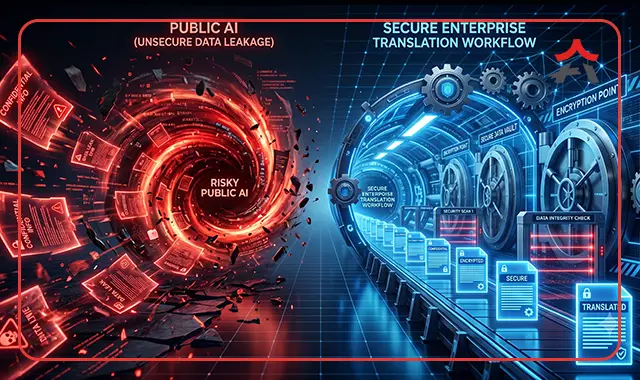
AI Overview
| Category | Summary |
| Topic | Confidentiality in Translation |
| Purpose | To highlight data privacy risks and compliance strategies in the age of AI translation. |
| Key Insight | Public MT tools pose data leak risks; enterprise-grade solutions are mandatory for secure, compliant workflows. |
| Best Use Case | Handling sensitive corporate, legal, or medical documents requiring strict data protection. |
| Risk Warning | Sharing proprietary data with public AI engines may violate GDPR, HIPAA, and other privacy regulations. |
| Pro Tip | Use dedicated, private translation engines that do not train on your user-provided content. |
A single data breach now costs organizations an average of $4.88 million globally, according to IBM’s 2024 Cost of a Data Breach Report. Healthcare organizations face even higher costs, with sensitive patient information among the most targeted data types. At the same time, companies are translating more content than ever before, from software documentation and clinical trial materials to customer support content and internal communications.
Machine translation has made multilingual communication faster and more accessible. Yet the same technologies that increase efficiency can also introduce serious confidentiality and compliance risks when sensitive information passes through systems that lack proper controls.
For localization managers, procurement officers, and language professionals, the conversation is no longer limited to translation quality. Questions about data handling, privacy regulations, and vendor accountability have become equally important.
This shift is particularly relevant for organizations operating across Asia, where data privacy regulations continue to evolve and differ significantly from one country to another.
Why Confidentiality Matters More Than Ever in Translation
Translation projects often contain information that organizations would never intentionally expose to the public.
Examples include:
- Product roadmaps and technical specifications
- Clinical trial documents
- Medical device instructions and regulatory submissions
- Patient records
- Financial reports
- Legal contracts
- Intellectual property filings
- Internal corporate communications
When these materials move through translation workflows, multiple stakeholders may access the content. Translators, reviewers, project managers, technology providers, and cloud platforms may all become part of the information chain. Every additional touchpoint increases potential risk.
The rapid adoption of machine translation has added another layer of complexity. Many public machine translation engines process text through cloud-based infrastructure. If users paste confidential content into systems without reviewing data processing policies, they may unintentionally expose proprietary or regulated information.
Several major organizations have already learned this lesson the hard way.
In 2023, reports emerged that employees at large enterprises had uploaded confidential company information into generative AI and machine translation-related tools. The incidents prompted restrictions on AI usage at multiple global corporations and highlighted growing concerns about data governance.
For industries such as technology, healthcare, and life sciences, these risks are particularly significant because a single disclosure can result in regulatory penalties, reputational damage, or loss of competitive advantage.
Understanding Compliance Requirements Across Global Markets
Confidentiality in translation is closely connected to regulatory compliance. Organizations operating internationally must navigate a growing network of privacy laws and industry requirements.
United States
In the United States, healthcare organizations often need to comply with HIPAA requirements when handling protected health information.
Medical device manufacturers may also face FDA documentation requirements and contractual confidentiality obligations when translating regulatory submissions, labeling, and technical documentation.
Technology companies handling customer data frequently encounter state-level privacy laws, including the California Consumer Privacy Act (CCPA) and similar regulations adopted by other states.
European Union
The General Data Protection Regulation (GDPR) remains one of the most influential privacy frameworks globally. GDPR requirements extend beyond Europe and affect organizations worldwide that process personal data belonging to EU residents.
Translation providers handling personal information must demonstrate appropriate safeguards, secure processing methods, and clear accountability procedures.
Asia’s Growing Privacy Landscape
Asia presents unique compliance challenges because regulations vary considerably between jurisdictions.
For example:

- Singapore’s Personal Data Protection Act (PDPA) establishes strict requirements for collecting, using, and disclosing personal information.
- Japan’s Act on the Protection of Personal Information (APPI) includes obligations related to cross-border data transfers and data handling practices.
- South Korea’s Personal Information Protection Act (PIPA) is widely regarded as one of the region’s most stringent privacy laws.
- China’s Personal Information Protection Law (PIPL) imposes significant requirements regarding personal data processing and international data transfers.
For localization managers overseeing multilingual content across Asia-Pacific markets, these varying regulations create additional operational complexity. A workflow that satisfies requirements in one jurisdiction may require adjustments elsewhere.
The Hidden Data Privacy Risks of Machine Translation
Machine translation offers undeniable advantages. Teams can translate large volumes of content quickly, reduce turnaround times, and support multilingual operations at scale. However, organizations should understand several key risks before incorporating machine translation into sensitive workflows.
Data Retention Policies
Not all machine translation platforms handle submitted content in the same way. Some services may retain data temporarily for quality improvement, system training, or operational purposes. Others offer enterprise environments with stricter controls and contractual guarantees. Understanding these differences is essential before uploading confidential material.
Cross-Border Data Transfers
Translation content often travels across servers located in different countries. This creates potential compliance challenges when regulations restrict how personal or sensitive information may be transferred internationally.
Lack of Access Controls
Consumer-grade translation tools rarely provide the level of user management, audit trails, and permission controls required by regulated industries. Organizations may struggle to demonstrate compliance during audits if translation activities occur outside approved systems.
Third-Party Exposure
Every external platform involved in a translation workflow introduces another potential point of vulnerability. Without proper vendor assessment procedures, organizations may have limited visibility into how their information is processed and protected.
AI Training Concerns
Many organizations remain cautious about whether submitted content could be used to improve future AI models. While policies vary among providers, concerns about intellectual property protection and confidential business information continue to drive demand for secure translation environments.
How 1-StopAsia Protects Confidential Information
At 1-StopAsia, confidentiality is not treated as an administrative checkbox. It is a fundamental component of project management, technology selection, and operational processes. Clients in technology, healthcare, life sciences, and other regulated industries expect rigorous safeguards throughout the translation lifecycle. To meet those expectations, 1-StopAsia employs multiple layers of protection.
Secure Translation Workflows
Every project follows structured workflows designed to minimize unnecessary access to sensitive information. Access permissions are assigned according to project requirements, ensuring that only authorized personnel can view client content.
Carefully Vetted Linguists
Human expertise remains a critical part of maintaining confidentiality. Translators and reviewers undergo screening processes and confidentiality agreements before participating in client projects. This is especially important for highly specialized content involving medical devices, software development, engineering documentation, and legal materials.
Secure Technology Infrastructure
Technology should support confidentiality rather than compromise it. Secure file transfer methods, controlled access environments, and encryption protocols help protect information during storage and transmission. Organizations increasingly expect language service providers to demonstrate strong cybersecurity practices alongside linguistic expertise.
Compliance-Focused Processes
Projects involving regulated content require more than translation accuracy. 1-StopAsia aligns workflows with relevant client requirements and industry standards, helping organizations manage obligations related to privacy, confidentiality, and regulatory compliance.
Regional Expertise Across Asia
Compliance challenges often arise from local market requirements rather than global regulations alone. A translation partner with deep knowledge of Asian markets can help clients navigate country-specific expectations, terminology standards, and regulatory considerations. This regional expertise becomes particularly valuable when projects span multiple jurisdictions such as Japan, South Korea, Singapore, China, Thailand, and Vietnam.
Case Example: Protecting Sensitive Medical Device Documentation
Consider a medical device manufacturer preparing product documentation for launch across several Asian markets.
The project included:
- Technical specifications
- Regulatory submission materials
- Quality management documents
- User instructions
- Product safety information
The content contained proprietary engineering information and regulatory data that required strict confidentiality controls.
A secure workflow was established with restricted user access, encrypted file transfers, designated linguist teams, and documented review procedures.
Translation memories and terminology databases were maintained within controlled environments rather than open public systems.
As a result, the client successfully completed multilingual regulatory submissions while maintaining compliance requirements and protecting sensitive intellectual property throughout the project lifecycle.
Organizations can strengthen this section further by incorporating project-specific metrics, turnaround times, compliance outcomes, or audit results where client approval permits disclosure.
Confidentiality Is Becoming a Competitive Requirement
Confidentiality in translation has become a business-critical issue. As machine translation and AI technologies continue to expand, organizations must evaluate not only how quickly content can be translated, but also how securely it is handled.
Strong privacy practices, secure technology infrastructure, vetted language professionals, and compliance-focused workflows all contribute to effective risk management.
At 1-StopAsia, these principles guide every stage of the translation process. By combining linguistic expertise with robust confidentiality standards and regional compliance knowledge, we help organizations communicate globally without compromising sensitive information.
If your organization handles confidential technical, medical, legal, or regulatory content, contact 1-StopAsia to discuss secure translation workflows tailored to your requirements.
If you find this article useful, consider sharing it on LinkedIn to continue the conversation around data privacy in translation.