AI Overview
| Category | Summary |
| Topic | How AI is transforming the localization of video content (dubbing, subtitling, translation) in Asian markets |
| Purpose | To inform media localization managers and streaming platforms about the benefits and limitations of AI tools in video content localization, emphasizing the need for human review to maintain cultural and emotional integrity. |
| Key Insight | While AI dramatically lowers costs and turnaround times in localization, it struggles with emotional nuance, cultural context, and tone adaptation, especially important in markets with complex linguistic and cultural norms such as Japan, China, and Korea. |
| Best Use Case | Global streaming platforms and media companies scaling content delivery across multiple Asian languages and regions, seeking to balance AI speed and cost-efficiency with human-driven quality control. |
| Risk Warning | Deploying AI dubbing or subtitles without sufficient human review can result in flat emotional delivery, cultural mismatches, and audience backlash as seen in the Amazon Prime Video Korean drama debacle. |
| Pro Tip | Use AI-generated outputs as a “first draft” and ensure native linguists and dubbing directors review all localized material for tone, pacing, cultural appropriateness, and emotional resonance before release. |
In May 2024, Amazon Prime Video quietly removed a batch of AI-dubbed Korean dramas from its catalog. Viewers had complained that the voices sounded flat and mechanical, stripped of the emotional range that made the original performances work. The story barely lasted a week in the news cycle, but it captured something bigger about where the industry stands right now. AI can dub, subtitle, and translate video content faster than any human team ever could, yet speed alone does not guarantee that audiences will accept the result.
For localization managers building media strategies for Asian markets, that gap between technical capability and audience trust is the story of the moment. AI dubbing costs for high-resolution content have dropped by more than 60 percent over the past two years, and localization timelines that once took six months can now close in a matter of weeks. The tools are real, and the pressure to adopt them is real too. What is less settled is how to use them without losing the qualities that made localized content work in the first place.
The Pain Points Behind Digital Media Localization at Scale
Traditional digital media localization was never simple, even before AI entered the picture. A single streaming title launching in Japan, South Korea, Vietnam, and Thailand needs separate linguistic treatment for subtitles, dubbing scripts, on-screen text, and marketing assets, each shaped by a different script, reading speed, and cultural register.
Three constraints kept slowing that process down. Cost sits at the top of the list: traditional full-cast dubbing for a single feature film in one language has historically run between 50 000$ and 100 000$. Multiply that across a slate of Asian markets and the number becomes prohibitive for anyone outside a handful of global streaming platforms. Time is the second constraint, since casting, recording, and lip-sync editing could take months per language, forcing companies to prioritize a few markets over a simultaneous launch. Cultural nuance is the third, and arguably the hardest to solve.
A joke that lands in Seoul may fall flat in Bangkok. Honorific systems in Japanese, tonal registers in Vietnamese, and strict character limits in written Chinese all demand more than a literal translation. Get it wrong, and attentive audiences in these markets notice immediately.
These three pressures are exactly what AI promises to address. Whether it delivers on all three at once is the question worth asking.
How AI Is Changing Media Localization Services
AI has moved from a supporting tool to a core part of many media localization services, reshaping how companies plan and budget for global releases.
Video Localization Speeds Up, But Not Without Risk
Video localization used to follow one script per language, timed by hand from start to finish. AI-assisted platforms now automatically generate first-pass timing, formatting, and rough translation, cutting the manual workload before a linguist ever opens the file. Netflix has reported cutting content localization turnaround from roughly six months to about four weeks using AI-supported workflows. The risk sits in the phrase “first pass”: automated timing still needs a human check, especially for content with fast-paced dialogue or overlapping speakers.
Video Translation Gets Smarter With Neural Machine Translation
Video translation increasingly starts with neural machine translation models trained on entertainment-specific language pairs rather than general-purpose engines. These models catch idioms and register shifts better than earlier statistical systems. However, they still stumble on wordplay, regional slang, and culturally specific references, the exact material that separates a strong localization from a merely passable one.
AI Video Dubbing: Efficiency Meets Its Limits
 AI video dubbing tools can now clone an actor’s voice, match lip movement, and generate a fully synced dub track within hours instead of weeks. Netflix has used this kind of technology to expand its dubbed catalog, reporting more than one hundred percent year-over-year growth in viewership of dubbed titles. The tradeoff is emotional range. Voice cloning models replicate pitch and rhythm convincingly but often flatten the delivery of jokes, grief, or sarcasm, the moments that call for an actor’s judgment rather than pattern matching.
Video Dubbing and the Cultural Nuance Problem
Video dubbing was always as much a performance as a translation task. A dubbing director adjusts pacing, chooses regional vocabulary, and decides how far a character’s tone should shift for a new audience. AI models reproduce the source performance closely, which is precise but not always appropriate. A character written as blunt in English may need to soften for a Japanese audience, where directness can read as rude rather than confident. That judgment call has not been automated, and recent audience reactions suggest it should not be rushed.
Chinese Subtitling: Character Limits Meet Machine Timing
Chinese subtitling carries its own technical constraints. Simplified and Traditional Chinese both compress meaning into fewer characters than English, so a subtitle line has to say more with less space and less reading time. AI timing tools are good at fitting text into a set duration, but they are not yet reliable at judging when a shorter, punchier phrase carries the same meaning as a longer English sentence. That judgment still belongs to a linguist who understands both the script constraints and the register the scene calls for.
Japanese Dubbing and the Weight of Tone
Japanese dubbing depends heavily on honorific systems and speech levels that shift according to age, status, and the relationship between characters. A line delivered in casual speech to a peer sounds jarring, even disrespectful, if a model defaults to a formal register, or the reverse. These distinctions carry real weight for Japanese audiences and are exactly the kind of context an AI system trained mainly on English-language patterns is likely to miss.
Case Study: What the Amazon Prime Video Backlash Actually Showed
The Amazon Prime Video situation is worth examining more closely, since it remains one of the clearest public examples of AI media localization meeting real audience resistance. In 2024, the platform introduced AI-generated dubbing for a set of Korean dramas that previously lacked dubbed versions in certain languages. Viewers described the voiceovers as flat and robotic and criticized the platform for showing little regard for the viewing experience. Within weeks, Amazon quietly pulled the AI-dubbed versions from its catalog.
The technology behind the dub was not really the problem. The voices were intelligible, timed correctly, and technically synced to the actors’ lip movements. What failed was emotional delivery, the layer of performance that signals whether a scene is meant to feel tense, romantic, or comic. K-drama audiences, who tend to be closely attuned to the emotional pacing of the genre, noticed the gap immediately and said so publicly.
The lesson for media companies expanding into Asian markets is not that AI dubbing should be avoided. It is that AI dubbing without a human quality layer, someone reviewing tone, pacing, and cultural fit before release, carries real reputational risk. Netflix has pursued a more layered approach, using AI to accelerate turnaround while keeping linguists and dubbing directors involved in review, and its reported growth in dubbed-content viewership suggests that balance is paying off.
A Balanced Path Forward
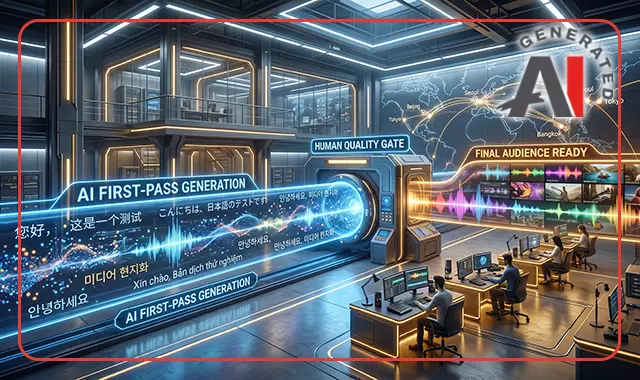
None of this means AI has no place in modern media localization. It means the highest-performing approach treats AI as a first-draft engine and human expertise as the quality gate. That combination lets companies scale into a large number of Asian markets without the six-figure budgets and multi-month timelines traditional dubbing once required, while still catching the tonal and cultural details automated systems tend to miss.
At 1-StopAsia, that principle shapes every subtitling and dubbing project we take on: AI tools handle the repetitive first pass, and linguists native to each target market handle tone, register, and cultural fit before anything reaches an audience. We explored the technical side of this balance in more detail in our earlier piece on how AI is reshaping subtitling and voiceover for global media.
Planning an AI-assisted media localization strategy for your next release in Asia? Contact 1-StopAsia for a consultation that pairs AI efficiency with native linguistic expertise across Chinese, Japanese, Korean, and Southeast Asian markets.