AI Overview
| Category | Summary |
| Topic | Operating high-volume technical content localization pipelines for Automotive OEMs |
| Purpose | To guide localization managers and technical program leads on achieving precision while scaling the localization of technical content. |
| Key Insight | Precision in technical localization is foundational, not optional, due to legal liability and brand trust. It requires a pragmatic, hybrid approach that integrates intelligent systems for automation with deep human expertise for nuance. |
| Best Use Case | Implementing an end-to-end strategy for continuous translation of complex content such as owner manuals, software interfaces, and compliance documentation to keep pace with tight product release cycles. |
| Risk Warning | Failing to maintain technical accuracy exposes OEMs to significant legal liability and risks damaging brand trust, as errors in safety instructions or compliance documents can have real-world consequences. |
| Pro Tip | Adopt a pragmatic, hybrid approach by leveraging integrated technology (like a TMS and CAT tools) for efficiency and using native linguists with technical backgrounds for quality assurance and in-context validation. |
Introduction: When Volume Meets Responsibility
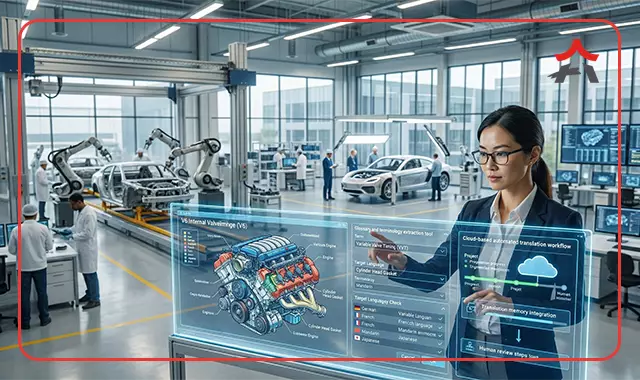
Modern automotive OEMs have evolved into global content engines, moving far beyond their roles as mere manufacturers. From owner manuals and service documentation to software interfaces and compliance materials, the volume of technical content produced today is staggering. Each vehicle launch can generate tens of thousands of pages across dozens of languages, all of which must meet strict regulatory and safety standards.
This is where the challenge intensifies: technical accuracy transcends quality control, becoming a fundamental legal obligation and a pillar of brand integrity. A mistranslated warning label or an ambiguous instruction in a repair manual can have real-world consequences.
For localization managers and technical program leads, the question is no longer whether to scale but how to scale without compromising precision.
This is precisely where a pragmatic, technology-enabled, and linguistically grounded approach becomes essential. High-volume technical localization now demands intelligent systems, disciplined workflows, and deep regional expertise.
Key Pain Points in Operating High-Volume Technical Pipelines
Managing high-volume technical localization in the automotive sector comes with a unique set of operational and strategic challenges.
1. Complexity of Technical Content
Automotive documentation is inherently complex. It spans:
- Mechanical engineering terminology
- Software and UI strings
- Safety and compliance documentation
- Diagnostic and repair instructions
Each content type has its own structure, tone, and terminology requirements. Maintaining technical accuracy across all of these, especially in multilingual environments, is a constant challenge. Even minor inconsistencies in terminology can lead to confusion among technicians or end-users. For example, inconsistent translation of a component name across documents can disrupt maintenance workflows or training programs.
2. Scale and Speed Pressures
Automotive OEMs operate on tight production and release cycles. Localization pipelines must keep pace with:
- Continuous product updates
- Regional compliance deadlines
- Simultaneous multi-market launches
This creates a high-pressure environment where volume and speed often threaten quality. Without structured workflows, teams risk bottlenecks, rework, and missed deadlines.
3. Fragmented Workflows
Many organizations still rely on fragmented localization ecosystems:
- Multiple vendors across regions
- Disconnected tools and platforms
- Manual handoffs between teams
This lack of integration leads to inefficiencies, duplicated effort, and inconsistent output. It also makes it difficult to implement continuous translation processes that can handle ongoing content updates seamlessly.
4. Linguistic Nuances Across Markets
Automotive terminology varies significantly across regions, especially in APAC markets.
For example:
- Japanese technical writing emphasizes precision and formality. There’s a strong preference for standardized terminology, often aligned with industry bodies or OEM-specific glossaries.
- Korean automotive terminology often blends native terms (for general concepts) and borrowed terms (e.g., “센서” for “sensor,” “모듈” for “module”)
- Chinese requires careful handling of simplified vs. traditional variants. Beyond script, there are also: terminology differences (same concept, different preferred term) and stylistic variations (tone, phrasing, sentence structure)
Without local expertise, even technically correct translations can feel unnatural or unclear to end users.
5. Risk of Legal Liability
Beyond the financial fallout, technical inaccuracies in this industry carry real-world safety consequences. Misinterpretation of safety instructions or compliance documentation can expose OEMs to significant legal liability. This elevates the importance of quality assurance from a best practice to a non-negotiable requirement.
Solutions and Methods for Precision at Scale
Achieving precision at scale requires a balanced approach – one that integrates technology with human expertise. This is where a structured, end-to-end localization strategy becomes critical.
1. Integrated Localization Technology Stack
A robust technical foundation is essential for managing high-volume workflows efficiently. Key components include:
- Translation Management Systems (TMS) for workflow orchestration
- Computer-Assisted Translation (CAT) tools for consistency
- API integrations for seamless content flow
- Automated file handling and formatting tools
By connecting these systems, organizations can eliminate manual handoffs and enable real-time collaboration across teams.
2. Terminology Management and Standardization
Consistency is the backbone of technical accuracy. Centralized terminology databases and glossaries ensure that:
- Key automotive terms are translated uniformly
- Brand voice is maintained across languages
- Updates are propagated across all content
In practice, this means building and continuously refining termbases that reflect both technical standards and regional preferences.
3. Continuous Translation Workflows
Traditional batch-based localization models are no longer sufficient. Automotive OEMs increasingly rely on continuous translation to keep pace with ongoing content updates. This approach enables:
- Incremental content processing
- Faster turnaround times
- Reduced backlog and rework
Continuous translation also supports agile development environments, particularly for in-vehicle software and digital interfaces.
4. Multi-Layered Quality Assurance
Quality control must be embedded at every stage of the pipeline. Effective QA frameworks typically include:
- Automated checks for terminology, formatting, and consistency
- Linguistic review by native experts
- In-context validation for UI and software strings
- Final proofreading for compliance-critical content
This layered approach ensures that errors are caught early and do not propagate through the system.
5. Local Expertise in APAC Markets
Technology alone cannot solve linguistic challenges. Deep local expertise is essential, especially in markets with complex language structures and evolving automotive terminology. For languages such as Japanese, Korean, and Chinese, successful localization requires:
- Native linguists with technical backgrounds
- Understanding of regional automotive standards
- Familiarity with user expectations and industry norms
Combining this expertise with centralized workflows allows for both consistency and localization depth.
6. A Pragmatic, Hybrid Approach
 What sets effective localization strategies apart is not just the tools used, but how they are applied. A pragmatic approach combines:
- Automation for efficiency
- Human expertise for nuance
- Data-driven insights for continuous improvement
This balance enables organizations to scale operations without sacrificing quality.
Case Example from the APAC Market
To illustrate how these principles come together in practice, consider a recent engagement with a Tier-1 automotive supplier operating across multiple APAC markets.
The Challenge
The client was managing a high-volume pipeline of technical documentation, including:
- Service manuals
- Diagnostic tools
- Software interface content
They faced several issues:
- Inconsistent terminology across languages
- Long turnaround times due to manual workflows
- Limited visibility into project status
- Increasing concerns around technical accuracy and compliance
The Approach
A structured localization framework was implemented, focusing on:
- Workflow Integration
API connections were established between the client’s content management system and the localization platform, enabling seamless content flow. - Centralized Terminology Management
A unified termbase was developed and aligned across all target languages, with input from regional experts. - Continuous Translation Model
The pipeline was restructured to support ongoing content updates rather than batch processing. - Enhanced QA Processes
Automated QA tools were combined with expert linguistic review, ensuring both speed and accuracy. - Regional Linguistic Alignment
Dedicated language leads in Japan, Korea, and China ensured that translations met local expectations and technical standards.
The Results
Within six months, the client achieved:
- 30% reduction in turnaround time
- Significant improvement in terminology consistency across all languages
- Higher first-pass quality, reducing the need for revisions
- Improved stakeholder satisfaction, particularly among regional teams
Conclusion: Precision as a Hardwired Requirement
Localization has become an industrial-scale operation, inseparable from the global automotive supply chain. As content volumes continue to grow and regulatory requirements become more stringent, the need for precision at scale will only intensify. High-volume technical localization is inherently complex. It requires:
- Seamless integration of technology
- Rigorous quality control processes
- Deep understanding of regional linguistic nuances
Organizations that succeed in this space are those that recognize the importance of balancing efficiency with expertise. A pragmatic, evidence-based approach, one that combines automation with human insight, enables OEMs and their partners to navigate this complexity with confidence.
If your organization is navigating the challenges of high-volume technical localization, now is the time to reassess your pipeline. Connect with 1-StopAsia for a tailored consultation and discover how a smarter, more integrated approach can optimize your workflows, improve technical accuracy, and deliver measurable results at scale.